
Nitroammophoska: uses, when and how to apply, rates per hectare
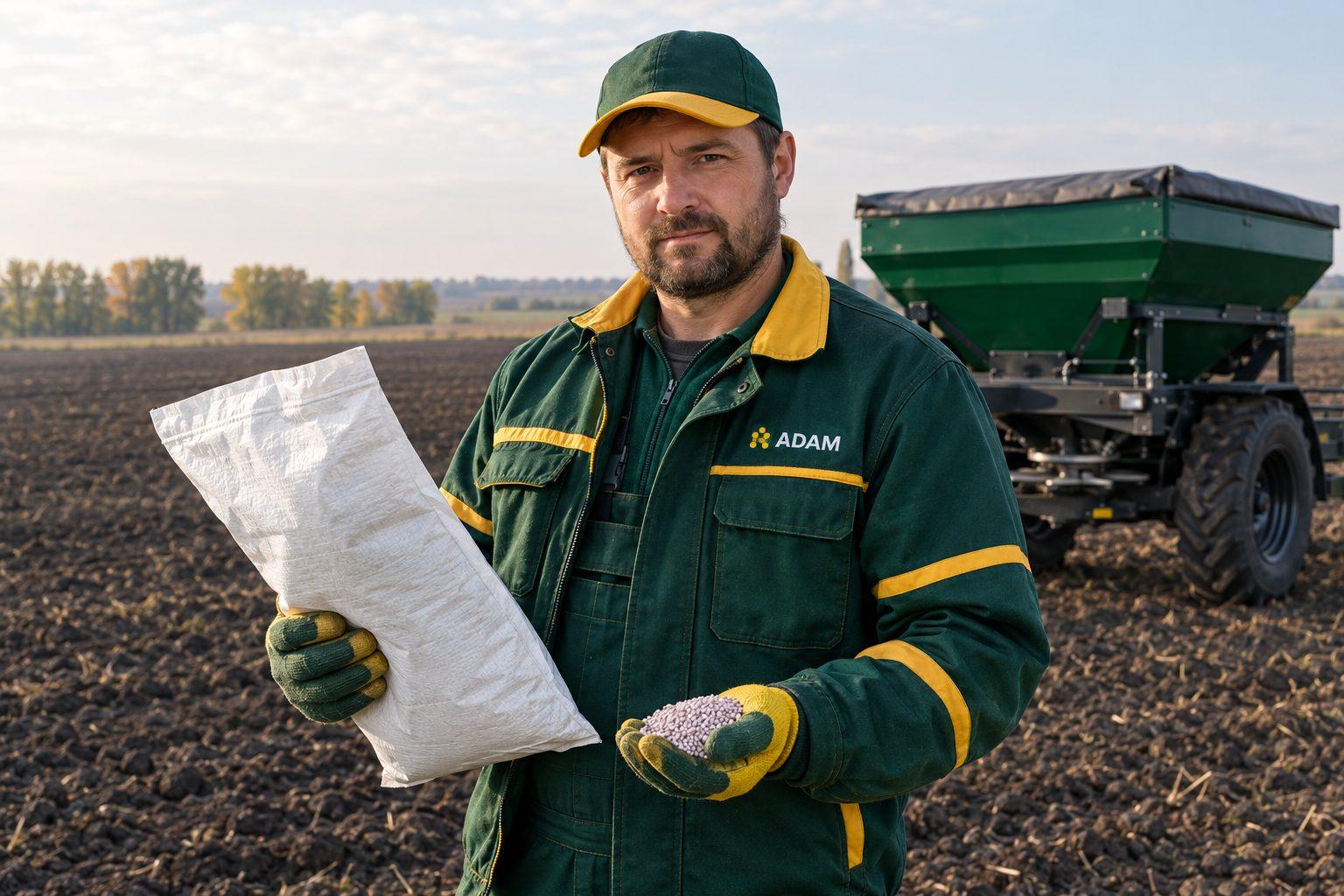
Nitroammophoska 16-16-16 and 15-15-15: what the numbers mean, which label lines to read, when to apply, rates per hectare for field crops, mixing with urea.
Nitroammophoska is a granular fertiliser with nitrogen, phosphorus and potassium in each granule; 16-16-16 gives the percentages of N, P₂O₅ and K₂O. It goes on before sowing or in small row doses, mostly 100-450 kg/ha by soil test. One 16-16-16 has nitrate, another none, so the label decides its action and mixing with urea.
Nitroammophoska (нітроамофоска) is a granular complex fertiliser that carries nitrogen, phosphorus and potassium in every granule. The grade numbers are the percentages of N, P₂O₅ and K₂O: the textbook «Агрохімія» (Agrochemistry) names 16-16-16 first among the nitroammophoska grades, and among the valid entries for granular balanced NPK in Ukraine's State Register of Pesticides and Agrochemicals the most frequent grade is 15-15-15 with sulphur.
It goes on before sowing, under the primary tillage or at pre-sowing cultivation, or as a small dose in the row at sowing. Registered and institute rates mostly fall within 100-450 kg of product per hectare, and the soil test gives the exact figure. The name does not fix the chemistry: in YaraMila 16-16-16, 6.5 of the 16% nitrogen is nitrate, while Elixir 16:16:16 has no nitrate. So how the fertiliser acts, and whether it can be mixed with urea, is decided by the label lines on nitrogen forms, water-soluble phosphorus and sulphur.
What nitroammophoska is
The textbook «Агрохімія» by H. M. Hospodarenko (2013) divides complex fertilisers into two groups by process: those made from phosphate raw material decomposed with nitric acid (nitrophos, nitrophoska) and those made from phosphoric acids (nitroammophos, nitroammophoska, ammophos, diammophos). Nitroammophoska, the textbook says, is made in the same way as nitroammophos, by neutralising nitric and phosphoric acids with ammonia, and potassium is added. Potassium chloride gives the grades 16-16-16, 17-17-17, 10-22-18, 10-26-26 and 13-19-19; potassium sulphate gives a chloride-free nitroammophoska. So in classic nitroammophoska the nitrogen is partly nitrate and partly ammonium.
The grade numbers are the percentages of N, P₂O₅ and K₂O: the YaraMila label gives phosphorus “as P₂O₅” and potassium “as K₂O”. Converted to elements, 16% P₂O₅ is about 7.0% phosphorus and 16% K₂O about 13.3% potassium (our calculation). So 100 kg of 16-16-16 supplies 16 kg each of N, P₂O₅ and K₂O. Catalogue section: NPK compounda; in the glossary: NPKa.
One name, different bags: four label lines
The name “nitroammophoska” does not guarantee the composition, so compare four lines on the label: the grade, the nitrogen forms (nitrate, ammonium, amide), the share of P₂O₅ that dissolves in water, and sulphur.
| Product | Nitrogen | P₂O₅ in water | Sulphur |
|---|---|---|---|
| YaraMila NPK 16-16-16 | nitrate 6.5%, ammonium 9.5% | 11.2 of 16% (70%) | not declared |
| Elixir NPK 16:16:16 | ammonium 14.7%, amide 1.3% | 14.4 of 16% (90%) | 10% |
| Elixir NPK 15:15:15 | ammonium 14%, amide 1% | 13.5 of 15% | 11% (27.5% SO₃) |
| Elixir Supreme 15:15:15 | ammonium 13.5%, nitrate 1.5% | 14 of 15% | 12% |
| “Nitroammophoska”, register entry А 04177 | N 18-24%, forms not stated | only 0.1% P₂O₅ | not stated |
One grade, different chemistry: in YaraMila two fifths of the nitrogen is nitrate, while Elixir 16:16:16 has no nitrate but carries 10% sulphur. The nitrogen form decides how it leaches and whether the fertiliser can be mixed with urea. The “nitroammophoska” of entry А 04177, with 0.1% P₂O₅, was by composition a nitrogen-potassium fertiliser. The instructions for nitroammophoska are the label on the bag. Product pages: YaraMila NPK 16-16-16a, Elixir NPK 16:16:16a, Elixir NPK 15:15:15a, Elixir Supreme 15:15:15a.
Grades: 16-16-16 and 15-15-15 with sulphur
As of November 2026, valid register entries for seven products name a granular nitroammophoska or a balanced grade. The table shows six of them plus Polifoska 15, whose grade its entry does not spell out; the seventh belongs to a company in a group linked to Russia, and we do not name it. 16-16-16 appears only in the Elixir entry, and 15-15-15 with sulphur is named in five.
| Entry, product, origin | Grade in the entry | Valid until |
|---|---|---|
| А 08062, Elixir (Serbia) | NPK 16:16:16 +25% SO₃; NPK 15:15:15 +27.5% SO₃ | 31.12.2029 |
| А 07978, AstraNorus (Saudi Arabia) | 15-15-15+11S | 31.12.2029 |
| А 08899 and А 06162, ГЛОБАЛ-NPK (GLOBAL-NPK; Serbia, Saudi Arabia) | 15:15:15+11% S | 31.12.2026 |
| А 09825, Info Kar (Ukraine) | NPK+S 15:15:15+11 | 31.12.2032 |
| А 08794 and А 07171, Polifoska (Poland) | POLIFOSKA 15, grade not spelled out; by the label NPK 15-15-15 + 20% SO₃ | 31.12.2030 and 31.12.2028 |
| А 08285 and А 06874, Nitroammophoska-M (Нітроамофоска-М), Tetra-Agro (Ukraine) | N 0-30%, P₂O₅ 0-30% (0-20% in А 06874), K₂O 0-40% | 31.12.2030 and 31.12.2028 |
| А 10361, Agromix, Binfield Logistic (Ukraine) | NPK 14:14:14 + 11% SO₃ + 2% CaO | 31.12.2033 |
10-20-20 and 8-24-24 are other ratios, and the register knows 20-20-20 only as a powder or crystals. In ADAM's catalogue three products carry 16-16-16 and seven carry 15-15-15, including Superagro NPK 15-15-15a and Polifoska 15; not all of them are in the register's public file.
Azofoska, nitrophoska, diammofoska, ammophoska: what the names mean
The trade uses the names of complex fertilisers loosely, so check the grade on the label. Hospodarenko's textbook tells them apart:
- <strong>Azofoska (азофоска).</strong> According to the textbook, azofos and azofoska are made by decomposing apatite concentrate with nitric acid; their grades are 23-21-0, 26-13-0, 16-16-16 and 21-11-11, with at least 85% of the phosphorus in water-soluble form. In the trade it is a synonym of nitroammophoska, and two lapsed register entries carried both names.
- <strong>Nitrophoska (нітрофоска).</strong> Also nitric-acid based, with potassium. No more than 50-60% of its phosphorus is water-soluble, so it is less effective in the row and for top-dressing, and almost as good in basal application.
- <strong>Diammofoska (діамофоска).</strong> Grade 10-26-26: 2.6 times less nitrogen than phosphorus and potassium. The textbook also counts 10-26-26 among the nitroammophoska grades, and the register lists this grade both as diammofoska and as NPK.
- <strong>Ammophos (амофос).</strong> Ammonium phosphate without potassium: 11-13% N and 44-52% P₂O₅ (grade A).
- <strong>Ammophoska (амофоска).</strong> A different fertiliser; we have seen its composition only on a seller's page, so we do not give it here.
What it is for and which crops
Nitroammophoska supplies nitrogen, phosphorus and potassium in one pass: in the basal application or in the row at sowing. Valid register entries for granular balanced NPK name small-grain cereals, maize, sunflower, sugar beet, industrial, oilseed, pulse and vegetable crops, and potato.
An even 1 : 1 : 1 ratio suits a need for roughly equal amounts of all three. The Institute of Grain Crops of NAAS, Ukraine's National Academy of Agrarian Sciences, advises an even ratio for sunflower in the Steppe (2021), N30-45 P30-45 K30-45, which allows an extra 0.3-0.4 t/ha of seed. The NAAS Institute of Oilseed Crops, for Zaporizhzhia oblast (2020), calls N40-60 P60-90 the most effective sunflower doses and writes that potash fertilisers are not worth applying on chernozems: here 16-16-16 would bring potassium the recommendation does not ask for. The soil test shows which grade you need.
The YaraMila 16-16-16 label for the Czech Republic recommends it for spring top-dressing of winter rapeseed and wheat that received no phosphorus and potassium in autumn, and for spring crops on soils poorer in these nutrients.
When to apply: autumn, spring, at sowing
The timing is set out in register entries and institute recommendations. Info Kar registers NPK+S 15:15:15 for small-grain cereals as a basal application in autumn, in spring at pre-sowing cultivation, or at sowing, 100-200 kg/ha once. Nitroammophoska-M also has in-season top-dressing. The NAAS Myronivka Wheat Institute (2023) advises applying phosphorus-potassium fertilisers, nitroammophoskas among them, under the primary tillage or at pre-sowing cultivation, and when they are placed locally at sowing the dose is cut by 30-50%.
Hospodarenko's textbook explains why autumn calls for more care on light soils: it is mainly nitrogen in nitrate form that leaches, most of all in early spring and late autumn. Phosphorus barely moves from where it was applied, even on light-textured soils, and potassium leaches in small amounts and only on sandy, sandy-loam and peat soils. Hence the common rule “heavy soils in autumn, light soils in spring”.
Winter wheat in autumn: why 16-16-16 falls short
In autumn winter wheat needs little nitrogen and a lot of phosphorus and potassium. Hospodarenko's textbook advises 20-30 kg/ha of nitrogen in the basal application when the plough layer holds less than 20 mg/kg of mineral nitrogen; the Myronivka Wheat Institute (2023) gives 25-30 kg/ha at pre-sowing cultivation or before sowing. The same institute asks for 60-120 kg/ha of active ingredient (a.i.) each of phosphorus and potassium, with the dose refined by soil test.
For phosphorus and potassium the institute lists diammofoska, nitroammophoskas, ammophos, liquid complex fertilisers and superphosphate. Which form to choose depends on how much nitrogen autumn allows on your field.
From a rate to kilograms of product
Institutes and textbooks give rates in kilograms of active ingredient, the label in kilograms of product. Divide the kilograms of a nutrient by its share in the grade: for 16-16-16 that is ÷ 0.16, or × 6.25, and for 15-15-15 × 6.67. A rate of N45 means 280 kg/ha of 16-16-16 or 300 kg/ha of 15-15-15 (our calculation). For the garden: 1 g/m² equals 10 kg/ha, and 1 kg per sotka (сотка, 100 m²) equals 100 kg/ha.
Registered and label rates of products:
| Product and source | Crops | kg/ha |
|---|---|---|
| NPK+S 15:15:15+11, Info Kar (register) | small-grain cereals | 100-200 |
| Polifoska (register) | cereals, industrial, vegetable, oilseed and pulse crops | 200-400, or 2-4 kg per sotka |
| AstraNorus (register) | small-grain cereals; maize; sunflower; sugar beet | 250-450; 150-500; 200-600; 150-700 |
| Nitroammophoska-M (register) | cereals, basal application | 270-750 |
| YaraMila 16-16-16 (label, Czech Republic) | wheat; spring malting barley; rapeseed; maize | 200-300; 100-150; 200-300; 300-400 |
| Elixir 16:16:16 (maker) | wheat; sunflower, soybean; barley; sugar beet | 250-450; 200-400; 250-400; 350-700 |
A registered rate applies to the product it was issued for; for a different bag, use that bag's label.
Rates for field crops
The table converts institute and textbook rates into kilograms of 16-16-16. Where the ratio is not 1 : 1 : 1, one nutrient caps the dose, and the others come out above or below their rate; for 15-15-15 the dose is 7% higher.
| Crop and source | Rate, kg/ha a.i. | 16-16-16, kg/ha |
|---|---|---|
| Spring wheat (Zinchenko, 2001) | 45-60 each of N, P, K | 280-375 |
| Winter barley, Forest-Steppe (Zinchenko, 2001) | 45-60 of every nutrient | 280-375 |
| Spring barley, left-bank and central Forest-Steppe, chernozems of the central and northern Steppe (Zinchenko, 2001) | N45 P30 K30 | 190-280 |
| Maize, Steppe, autumn (Institute of Grain Crops, NAAS, 2021) | N40-45 P45 K30 | 250-280 |
| Sunflower, Steppe (Institute of Grain Crops, NAAS, 2021) | N30-45 P30-45 K30-45 | 190-280 |
| Soybean (Hospodarenko, 2013) | N30-60 before sowing, P and K 45-60 | 190-375 |
| Winter rapeseed, under ploughing (Zinchenko, 2001) | N30-45 P45-60 K45 | 280-375 |
For spring barley, 190 kg/ha gives N30 P30 K30, and 280 kg/ha gives N45 with a surplus of phosphorus and potassium. For sunflower the recommendations differ: the Institute of Grain Crops asks for an even ratio in the Steppe, the Institute of Oilseed Crops for N40-60 P60-90 without potassium on the chernozems of Zaporizhzhia oblast, and Hospodarenko's textbook for 45-90 kg/ha of nitrogen, phosphorus and potassium, that is 280-560 kg/ha of 16-16-16.
In the row at sowing
Row doses in the textbooks are small. For sugar beet, according to Hospodarenko, N10-15 P10-15 K10-15 goes into the row at sowing, preferably as complex fertilisers, and the textbook names nitroammophoska: that is 62-94 kg/ha of 16-16-16 (our calculation), and the gain is 2-3 t/ha of roots. For sunflower, N10-15 P15-30 as complex fertilisers; here nitrogen caps 16-16-16, so again 62-94 kg/ha. For winter rapeseed Zinchenko gives 10-15 kg/ha each of nitrogen, phosphorus and potassium at sowing in complex granular fertilisers, which is also 62-94 kg/ha.
For maize, row fertiliser should carry no more than 5 kg/ha of nitrogen, that is up to 31 kg/ha of 16-16-16, and a 2-4 cm layer of soil separates the seed from the fertiliser. We found no doses for side-band placement in the sources.
Local placement, according to the textbook, raises the use of nitrogen by 10-15%, phosphorus by 5-10% and potassium by 10-12% compared with broadcasting. The register allows Nitroammophoska-M 90-270 kg/ha in the row for cereals: work out how much nitrogen that gives with your grade.
Potato
Among valid entries for granular balanced NPK, only Nitroammophoska-M from Tetra-Agro (А 08285 and А 06874) names potato directly; А 08285 spells out the rates: “vegetable crops and potato”. Its rates per hectare, per sotka and per square metre:
| Application | kg/ha | kg per sotka | g/m² |
|---|---|---|---|
| basal, once | 300-600 | 3-6 | 30-60 |
| in the row, once | 90-150 | 0.9-1.5 | 9-15 |
| top-dressing, up to 4 times | 90-225 | 0.9-2.25 | 9-22.5 |
Polifoska gives 2-4 kg per sotka for cereals, industrial, vegetable, oilseed and pulse crops, but does not name potato separately. For Supreme 15:15:15, Elixir states 800-1100 kg/ha for potato (maker's page). None of the granular nitroammophoska labels we opened gives a rate for spraying potato on the leaf. The soil test shows how much you need to apply.
Vegetables, berries and grapes in the garden
In the garden the rate is counted in grams per square metre: 1 g/m² equals 10 kg/ha. So the common garden 20-50 g/m² is 200-500 kg/ha, the same field rate (our calculation). Register entries and makers give:
- <strong>Vegetable crops, Nitroammophoska-M:</strong> 30-60 g/m² as a basal application.
- <strong>Vegetable crops, Polifoska:</strong> 20-40 g/m², that is 2-4 kg per sotka.
- <strong>Fruit and berry crops and vineyards, «ЯРИЛО NPK+МЕ» (Yarylo NPK+ME, А 09982; the entry does not spell out grades):</strong> root and foliar feeding at 0.01-2.5 kg per 100 m², that is 0.1-25 g/m², 1-2 times.
- <strong>Fruit crops, according to Elixir for 16:16:16:</strong> 300-600 kg/ha, that is 30-60 g/m².
None of these entries names strawberries, raspberries, garlic, tomatoes or cucumbers separately: they fall into the groups “vegetable crops” or “fruit and berry crops”, and the product label gives the rate. Elixir registers tomatoes and grapes only for other grades, NPK 10:10:20 and 7:20:30. Flowers, lawns and conifers are not covered here.
How to dissolve it, and can it go on the leaf
A nitroammophoska granule does not dissolve completely in water. By the YaraMila 16-16-16 label, 11.2 of the 16% P₂O₅ dissolves in water, that is 70%; the rest of the phosphorus dissolves only in neutral ammonium citrate, not in water. In Elixir 16:16:16 the water-soluble P₂O₅ is 14.4 of 16%, or 90%. The potassium in both is fully water-soluble. So part of the granule will remain as sediment.
None of the labels or register entries we opened gives a rate per 10 L of water for a granular balanced NPK. A solution only carries the same rate in grams per square metre: as many grams as you dissolved will reach the watered area.
We found no rates for spraying granular NPK on the leaf either: in the register such rates belong to fertilisers for foliar feeding, such as NPK 18-18-18 in the «АЗОПЛОН Нутрі» (Azoplon Nutri) entry, 2-4 kg/ha. The «ЯРИЛО NPK+МЕ» entry names root and foliar feeding together, with one rate of 1-250 kg/ha and no solution strength. On a water-soluble fertiliser for the leaf: monopotassium phosphatea.
Mixing with urea and other fertilisers
On an NPK without nitrate, such as Elixir 16:16:16, neither of these sources says anything directly: check the condition with the maker. Fertilizers Europe rates a urea-based NPK as compatible with urea. There is a separate articlea on urea.
- <strong>Ammonium nitrate, ammonium sulphate, potassium chloride:</strong> according to the textbook, only shortly before application to the soil; Fertilizers Europe rates them as of limited compatibility with an ammonium nitrate based NPK.
- <strong>Superphosphate, ammophos, diammophos:</strong> according to the textbook, also only shortly before application; Fertilizers Europe rates superphosphate, MAP and DAP as compatible with such an NPK.
- <strong>Nitroammophos, nitrophos:</strong> can be mixed (textbook).
Nitroammophoska, ammonium nitrate, urea and superphosphate
Which of them is “better” depends on the job: they are compared by composition. Ammonium nitrate and urea supply only nitrogen, superphosphate supplies phosphorus, and the simple kind also sulphur from gypsum. Nitroammophoska brings another kilogram each of P₂O₅ and K₂O with every kilogram of nitrogen, so per 1 kg of nitrogen you need more than twice as much of it as of ammonium nitrate.
| Fertiliser | Composition | How much per 1 kg of N or P₂O₅ |
|---|---|---|
| Nitroammophoska 16-16-16 | 16% each of N, P₂O₅, K₂O | 6.25 kg, with 1 kg each of the other two |
| Ammonium nitrate | 34.4% N, half of it nitrate | 2.9 kg per 1 kg of N |
| Urea | 46% N, amide | 2.2 kg per 1 kg of N |
| Simple superphosphate | 19-21% P₂O₅, up to 50% gypsum | 4.8-5.3 kg per 1 kg of P₂O₅ |
| Double superphosphate | 42-50% P₂O₅ | 2.0-2.4 kg per 1 kg of P₂O₅ |
When people ask “saltpetre or nitroammophoska” («селітра чи нітроамофоска»), check which saltpetre is meant: potassium nitrate is 12-14% N and 45-47% K₂O. More: ammonium nitratea, superphosphatea, saltpetre or ureaa.
What it looks like: colour and granules
None of the register entries, labels or maker pages we opened states the colour of nitroammophoska. Seller sites and articles describe it as grey, light grey or pale pink, white or pink, white-pink and “pinkish-milky”.
The colour may depend on the raw material. Mosaic writes of potassium chloride that its colour ranges from red to white depending on the ore, that trace amounts of iron oxide give the reddish tint, and that there is no agronomic difference between the red and white forms. So colour does not tell you the quality of the fertiliser: the label shows the composition.
Granule size is stated by the makers: in YaraMila 16-16-16 at least 85% of the granules are 2-4 mm, in Grossdorf nitroammophoska 15-15-15 at least 95% are 3-5 mm, and in UAPG's NPK 15:15:15+10S at least 80% are 2-4 mm (supplier data in ADAM's catalogue).
Storage, shelf life, safety
Shelf life and hazards are set by the documents of the specific bag. The YaraMila 16-16-16 label gives 24 months from delivery if the storage conditions are kept, and states that the fertiliser is not subject to the ADR/RID rules for the transport of dangerous goods. Bags are kept in dry stores, and bulk fertiliser in heaps up to 6 m high, at least 2 m apart.
On seller sites the shelf life ranges from 6 to 60 months, and one and the same page calls nitroammophoska both explosive and not explosive. An NPK without nitrate, such as Elixir 16:16:16, contains no ammonium nitrate at all. So take the properties from the label and the safety data sheet of your own bag.
Granule dust, according to the Yara label, irritates the skin, airways and eyes: work in protective clothing and gloves and, if needed, a respirator and goggles.
Common mistakes
- <strong>Buying by the name.</strong> “Nitroammophoska” on the bag guarantees neither nitrate nitrogen, nor sulphur, nor even phosphorus.
- <strong>16-16-16 as the autumn base for winter wheat.</strong> The nitrogen rate caps the dose, and phosphorus and potassium come out 2-6 times below the institute's rate.
- <strong>Urea with a nitrate-containing NPK.</strong> The mixture quickly becomes wet.
- <strong>A broadcast rate in the row.</strong> For maize, at most 5 kg/ha of nitrogen in the row, up to 31 kg/ha of 16-16-16.
- <strong>A garden spoon in the field.</strong> Convert with 1 g/m² = 10 kg/ha.
- <strong>Colour as a sign of quality.</strong> The label shows the composition, not the colour.
- <strong>Spraying a solution of granules.</strong> Labels give no foliar rates, and part of the phosphorus stays as sediment.
How we checked this. The text was prepared with AI help from ADAM's research notes. On 11 November 2026 a separate AI-assisted check reopened the register file, the Yara and Polifoska labels, the Elixir pages, the Hospodarenko and Zinchenko textbooks, the NAAS institute recommendations and Fertilizers Europe, and compared every number. The calculations were redone.
Sources
- State Register of Pesticides and Agrochemicals, Ministry of Economy public file pesticides_19.10.2026 (page 20.10.2026, newest row 24.06.2024), read 10.11.2026, re-read 11.11.2026 · me.gov.ua
- Yara Agri Czech Republic: YaraMila NPK 16-16-16 label (PDF, 27.01.2012) · agrofert.cz
- Elixir Group: NPK 16:16:16 product page (undated, re-read 11.11.2026) · elixirgroup.rs
- Elixir Zorka: NPK 15:15:15 product page (undated, read 11.11.2026) · elixirzorka.rs
- Elixir Zorka: Elixir Supreme 15:15:15 product page (undated, read 11.11.2026) · elixirzorka.rs
- Elixir Group: NPK 15:15:15 product page (undated, read 11.11.2026) · elixirgroup.rs
- Agrofert / Grupa Azoty Police: Polifoska 15 NPK(SO3) 15-15-15 + (20) label, Czech market (PDF, 16.08.2016) · agrofert.cz
- Hospodarenko: Agrochemistry, textbook, Kyiv: Ahrarna osvita, 2013 (pp. 92-94, 119, 149-154, 189-190, 283, 296-309, 325) · learn.zhatk.zt.ua
- Zinchenko, Salatenko, Bilonozhko: Crop production, textbook, 2001 (pp. 221, 234, 241, 390) · lib.dsau.dp.ua
- NAAS Myronivka Wheat Institute: Seed winter wheat growing technology, 2023 (p. 18) · mip.com.ua
- NAAS Institute of Grain Crops: recommendations for the Steppe, 2021 (pp. 18, 44) · market.institut-zerna.com
- NAAS Institute of Oilseed Crops: spring field work in Zaporizhzhia oblast, recommendations, 2020 (p. 35) · imk.zp.ua
- Fertilizers Europe: Guidance for the compatibility of fertilizer blending materials (PDF, 20.05.2014) · fertilizerseurope.com
- Mosaic Crop Nutrition: Potassium Chloride (undated, re-read 11.11.2026) · cropnutrition.com
Frequently asked questions
Which is better: saltpetre or nitroammophoska?
They are fertilisers for different jobs, so they are compared by composition. Ammonium nitrate supplies 34.4% nitrogen, half of it nitrate, with no phosphorus or potassium. Nitroammophoska 16-16-16 brings another kilogram each of P₂O₅ and K₂O with every kilogram of nitrogen, and per 1 kg of nitrogen you need 6.25 kg of it against 2.9 kg of ammonium nitrate. Potassium nitrate is 12-14% N and 45-47% K₂O.
When is nitroammophoska applied?
Mostly before sowing: in autumn under the primary tillage or in spring at pre-sowing cultivation, and also as a small dose in the row at sowing. That is how, for example, Info Kar registers NPK+S 15:15:15 for small-grain cereals. On light soils autumn calls for more care: nitrate nitrogen leaches most in late autumn and early spring, while phosphorus barely moves.
What colour is nitroammophoska fertiliser?
There is no single colour. Neither the register nor the labels we opened state a colour, and sellers describe it as grey, white, pink or white-pink. The raw material may give the tint: potassium chloride, according to Mosaic, ranges from red to white with no agronomic difference. The composition on the label shows the quality.
What is fed with nitroammophoska?
Valid register entries for granular balanced NPK name small-grain cereals, maize, sunflower, sugar beet, industrial, oilseed, pulse and vegetable crops, and potato, and the «ЯРИЛО NPK+МЕ» entry, which does not spell out grades, also names fruit and berry crops and vineyards. It mostly goes on in the basal application or in the row; Nitroammophoska-M registers in-season top-dressing, 90-360 kg/ha twice for cereals.
When should garlic be fed with nitroammophoska?
None of the register entries we read gives a separate timing or rate for garlic: garlic falls into the group “vegetable crops”. For that group Nitroammophoska-M registers a basal application of 30-60 g/m² and in-season top-dressing of 9-22.5 g/m² up to four times (300-600 and 90-225 kg/ha). The product label gives the timing of top-dressing.
Can nitroammophoska be used to feed grapes?
No valid 15-15-15 or 16-16-16 entry names grapes. Vineyards are named by the «ЯРИЛО NPK+МЕ» entry, which does not spell out grades: root and foliar feeding at 1-250 kg/ha, 1-2 times, and 0.01-2.5 kg per 100 m² for household plots. Elixir registers grapes only for the grade NPK 7:20:30, 300-650 kg/ha. So take the rate from the label of a product whose entry names grapes.
Can urea be mixed with nitroammophoska?
No, if the label shows nitrate nitrogen. Hospodarenko's textbook «Агрохімія» marks this pair “must not be mixed”, and Fertilizers Europe writes that urea with an ammonium nitrate based NPK quickly becomes wet, turning into a liquid or slurry. These sources say nothing directly about an NPK without nitrate, such as Elixir 16:16:16, so check the condition with the maker.