
Urea as a fertiliser: what it is for, rates per hectare and how to dilute it
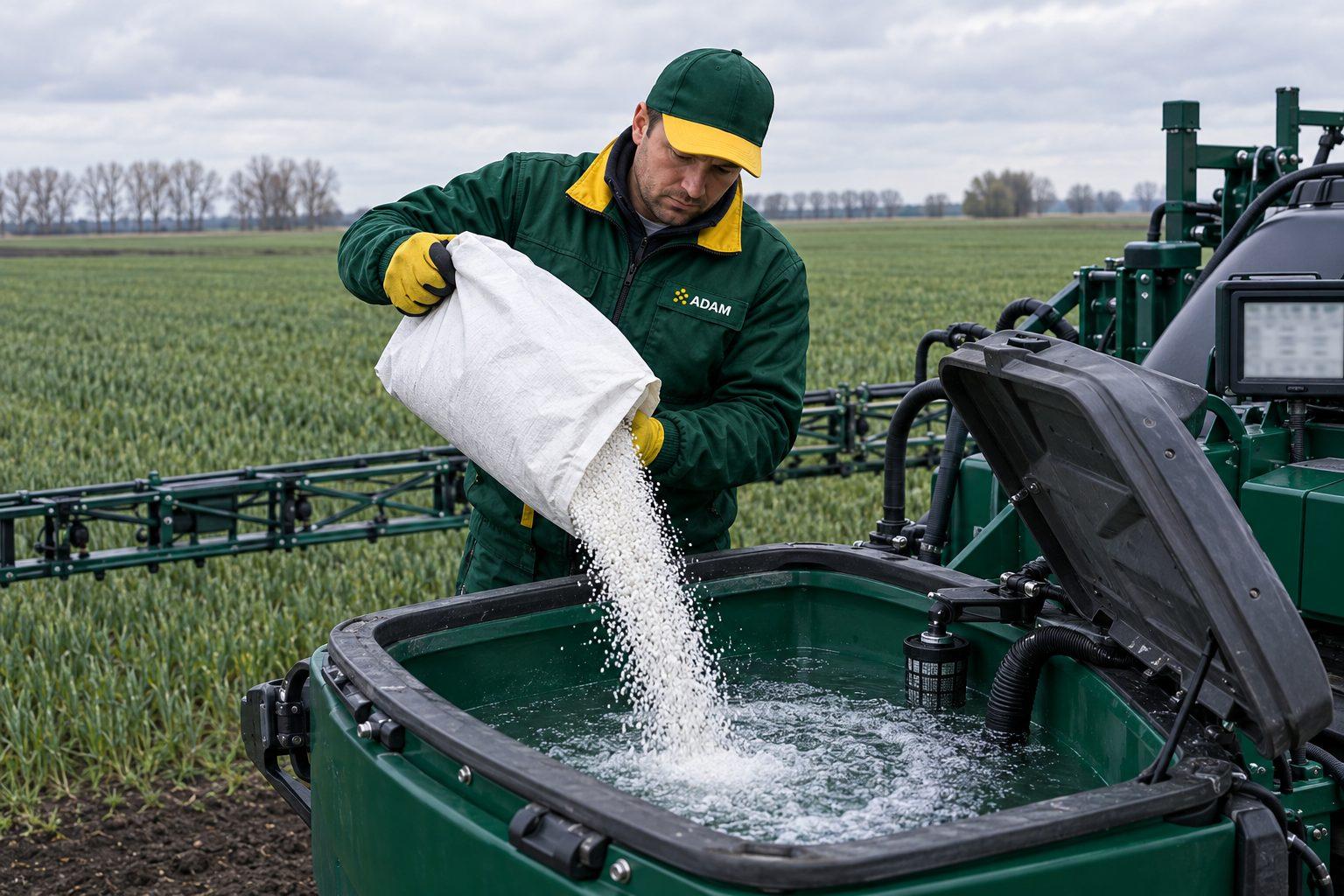
Urea (carbamide) as a fertiliser: what it is for, rates per hectare from NAAS institutes, the spray strength for wheat by stage, and what to mix it with.
Urea (carbamide) is a nitrogen fertiliser: at least 46.2% N (DSTU 7312:2013). With no registration required, the rates come from NAAS institutes. On soil it is worked in at once. Institutes cut the winter wheat spray strength from 15-20% in spring to 3-6% at heading; grams per 10 L depend on litres per hectare.
Urea, also called carbamide (карбамід) or сечовина, is a nitrogen fertiliser with the formula CO(NH₂)₂: under Ukraine's standard DSTU 7312:2013 it contains at least 46.2% nitrogen, all of it in the amide form. The law lets urea be sold and used without state registration, so there is no registered rate: the rates come from NAAS institutes (the National Academy of Agrarian Sciences of Ukraine), in kilograms of nitrogen per hectare. On the soil, urea is worked in at once, or part of the nitrogen escapes to the air as ammonia. For spraying winter wheat, the NAAS Myronivka Wheat Institute (recommendations for seed crops, 2023) weakens the solution as the crop develops: 15-20% at the first spring top-dressing, 8-10% at the start of stem elongation and 3-5% from heading, up to 8% only with enough moisture, below +20 °C and in the evening. How many grams go into 10 L depends on how many litres of solution go on a hectare.
What urea is: карбамід, сечовина and мочевина
Карбамід, сечовина and мочевина (the Russian name) are one substance, CO(NH₂)₂, which English calls urea or carbamide. Ukraine's standard is named that way too: DSTU 7312:2013 «Сечовина (карбамід). Технічні умови» (Urea (carbamide). Specifications), in force since 01.01.2014, replacing GOST 2081-92. There is no choosing between карбамід and сечовина: it is one fertiliser. The word сечовина also names the substance in human blood and urine, but this page is only about the fertilisera.
The standard has grade A (А) for industry and grade B (Б) for crop growing, livestock and retail. Requirements for grade B:
- nitrogen at least 46.2% on dry matter (45.5% if a nitrogen-containing additive against caking is added);
- biuret at most 1.4%, in retail packs up to 1.5%;
- water at most 0.3% (by the drying method);
- at least 94% of granules 1-4 mm in size; granules white or slightly coloured, with no foreign matter.
Off the field, urea goes into feed additives for livestock and into the fluid for diesel exhaust cleaning systems (AdBlue).
Why urea has no registered rate
The Law «On Pesticides and Agrochemicals» forbids importing, selling and using agrochemicals before state registration, but exempts those listed in the law's annex. The annex appeared in 2015 (Law No. 867-VIII of 08.12.2015), and «Сечовина (карбамід)» (urea) stands in it on two lines: with nitrogen above 45% and at most 45%. The current edition of the law, of 15.11.2024, keeps this list (as of 19.10.2026; last checked 11.11.2026).
So there is no registered rate either. The public file of the State Register of Pesticides and Agrochemicals holds 44 entries for straight urea, registered from 2008 to 2017. None of them is valid: the last, А 05001, expired on 31.12.2025. And none of these entries had a rate, only a list of crops, such as «Зернові, овочеві, технічні культури, в т.ч. для роздрібного продажу населенню» (grain, vegetable and industrial crops, incl. for retail sale to the public). Valid entries with urea in their composition belong to other products. The file ends with an entry of 24.06.2024. So the urea rate is taken from the recommendations of NAAS institutes.
How urea feeds a crop: through the soil and through the leaf
All the nitrogen in urea is amide. In the soil, the enzyme urease turns it into ammonium carbonate, on fertile soil with good moisture and temperature within 2-3 days (H. M. Hospodarenko's textbook «Agrochemistry», 2013). Ammonium carbonate breaks down on the soil surface, and ammonia escapes to the air. That is why urea spread on top is worked in, and a urease inhibitora slows this process.
A leaf takes up urea as a whole molecule, with no conversion in the soil. That is why the textbook calls urea the most effective form for foliar feedinga, and why the institutes give strengths for it by growth stage. How much nitrogen a foliar pass carries depends on strength and volume: a 10% solution at 200 L/ha carries 9.2 kg of nitrogen per hectare (calculation), while the Institute of Grain Crops gives 40-60 kg/ha for a soil top-dressing of winter wheat at tillering.
Winter wheat: nitrogen rates per hectare
The institutes give the rate in kilograms of nitrogen. To get kilograms of urea, the nitrogen is divided by 0.46.
| Pass | Nitrogen, kg/ha | Urea, kg/ha (calculation) | Source |
|---|---|---|---|
| Basal, only if mineral nitrogen in the plough layer is below 20 mg/kg | 20-30 | 43-65 | Hospodarenko, 2013, p. 283 |
| Tillering, start of stem elongation, crops that overwintered well, placed locally | 40-60 | 87-130 | NAAS Institute of Grain Crops, Steppe, 2021, p. 18 |
| Late, for grain quality, by spraying: flag leaf or from heading to milk ripeness | 30-40 | 65-87 | NAAS Institute of Oilseed Crops, 2020, p. 15 |
The Institute of Grain Crops advises setting the tillering dose «in all cases» by a soil test of the 0-60 cm layer. The Myronivka institute top-dresses in spring when nitrate in the plough layer is below 8-10 mg/kg or leaf nitrogen below 4.9%. For the late top-dressing, the Institute of Grain Crops names leaf nitrogen at heading as the criterion, «не менше 3 %» (at least 3%). The Myronivka institute gives the first top-dressing, on frozen-thawed soil, as 25-30% of the full nitrogen rate.
Maize, sunflower, sugar beet, rapeseed, soybean
For other crops the institutes also give nitrogen per pass; urea is calculated by dividing by 0.46.
| Crop | When | Nitrogen, kg/ha | Urea, kg/ha |
|---|---|---|---|
| Maize, Steppe | in autumn under main tillage; as a top-dressing | 40-45; 15-20 | 87-98; 33-43 |
| Sunflower | 2-3 leaf pairs, where moisture is enough and no fertiliser went in at basal application | 30 | 65 |
| Sugar beet | one top-dressing at 1-2 leaf pairs, with the first inter-row loosening | 30-40 | 65-87 |
| Winter rapeseed | under pre-sowing tillage | 30-40 | 65-87 |
| Soybean | only if nodules are few and the soil is well moistened | 30 | 65 |
For maize, the textbook gives no more than 5 kg/ha of nitrogen in the row at sowing, and an N30-40 top-dressing at the first inter-row cultivation only on light soils, while plants are shorter than 20 cm. Weak winter rapeseed is top-dressed in autumn, no later than the first ten days of October, with 20-30 kg/ha of nitrogen as ammonium nitrate, or sprayed with an 8-10% urea solution.
On the soil: work it in at once or lose nitrogen
According to Hospodarenko's textbook, when urea is surface-applied without immediate incorporation and there is no rain, ammonia losses can reach 30-50% of the nitrogen applied, against 1-3% from ammonium nitrate (2-4.3% by EMEP/EEA 2023). How much exactly depends on weather and soil:
| Conditions | Nitrogen lost from urea | Source |
|---|---|---|
| Worked in the same day, or about 13 mm of rain fell in one go within 24 hours | 3-6% | Germany's inventory (UBA, 2025); Kansas State University |
| On the surface, cool, soil pH 7 or below | 10-16% | EMEP/EEA 2023; Montana State University |
| On damp soil that then dries; warm, pH above 7 or on crop residue | 20-40% | Montana State University; Manitoba |
| On snow | 20-25% | Montana State University |
Light rain does not stop the losses and can increase them, and urea is not applied to damp soil even in the cold (Montana). For the spring top-dressing of winter wheat, the Institute of Grain Crops prefers fertilisers with nitrate nitrogen, ammonium nitrate and UAN; the two fertilisers are compared in ammonium nitrate or ureaa. Placed locally at sowing, the textbook gives 70-100 kg/ha of urea 5-8 cm to the side of the row. Urea's spreading width, per the textbook, is a third narrower than ammonium nitrate's; the spreader's table gives the exact one.
Foliar urea on winter wheat: strength by growth stage
Two NAAS institutes give the strength for each stage:
| Stage | Myronivka Wheat Institute, 2023 | Institute of Oilseed Crops, 2020, maximum |
|---|---|---|
| Early spring: first top-dressing, tillering | 15-20% | 18-20% at the start, 16-18% at the end of tillering |
| Stem elongation | 8-10% at the start | 10-12% at the start, 6-8% at the end |
| Heading | 3-5%; up to 8% with enough moisture, below +20 °C, in the evening | 5-6% |
| Flowering | not named separately | a dash |
| Grain fill, milk ripeness | 3-5% | 4-5% |
Higher strengths come from Hospodarenko's textbook, 30-45 kg/ha of nitrogen from heading to the start of milk ripeness as a 10-30% solution, and from the Henichesk experimental station of the Institute of Grain Crops: 23-26 kg/ha of nitrogen at milk ripeness in 200-250 L of solution per hectare, about 20-28% (calculation).
The late top-dressing works on quality: protein rises by 1.5-2.0% in the textbook, by 1.5-2.5% at the Henichesk station, by 0.7-1.2% in the Steppe per the Institute of Grain Crops. The Institute of Oilseed Crops finds it worthwhile only where the grain can move up a class. The British AHDB review gives about 0.8% protein per 30 kg/ha of nitrogen, best from flowering to milk ripeness.
From per cent to kilograms per hectare and grams per 10 litres
The Institute of Grain Crops explains its per cent with an example: «5 % розчину карбаміду (10 кг/га препаративна форма + 190 л/га вода)» (a 5% urea solution: 10 kg/ha of product plus 190 L/ha of water). That is 5 kg of urea per 100 kg of finished solution, not per 100 L of water.
| Strength | Urea per 10 L of water | Urea per hectare at 200 and 300 L of solution | Nitrogen per hectare at 200 and 300 L |
|---|---|---|---|
| 3% | 309 g | 6 and 9 kg | 2.8 and 4.1 kg |
| 5% | 526 g | 10 and 15 kg | 4.6 and 6.9 kg |
| 8% | 870 g | 16 and 24 kg | 7.4 and 11.0 kg |
| 10% | 1.11 kg | 20 and 30 kg | 9.2 and 13.8 kg |
| 15% | 1.76 kg | 30 and 45 kg | 13.8 and 20.7 kg |
| 20% | 2.50 kg | 40 and 60 kg | 18.4 and 27.6 kg |
| 30% | 4.29 kg | 60 and 90 kg | 27.6 and 41.4 kg |
So first find the litres per hectare. A knapsack sprayer at 10 L per сотка (100 m²) puts out 1 000 L/ha, and a 10% solution then carries 100 kg of urea, 46 kg of nitrogen, per hectare (calculation).
Foliar urea on maize, rapeseed, soybean, beet and spring cereals
| Crop | Stage | Strength, volume | Source |
|---|---|---|---|
| Maize | 6-7 leaves, instead of a soil top-dressing | 5% at 300 L/ha, i.e. 15 kg of urea (calculation) | Institute of Grain Crops, 2021, p. 44 |
| Winter rapeseed | weak plants in autumn; before flowering together with pesticides | 8-10%; before flowering several times 8-12% at 300 L/ha | Hospodarenko, 2013, pp. 317-318 |
| Soybean | start of pod formation | 3% with 0.05% boric acid | Hospodarenko, 2013, p. 296 |
| Sugar beet | foliar top-dressing | 6%, up to 10% only when cool and cloudy | Hospodarenko, 2013, p. 306 |
| Spring cereals | tillering | 10-15 kg/ha of nitrogen as urea solution | Institute of Grain Crops, 2021, p. 55 |
For maize after sunflower, the Institute of Grain Crops gives another option too: 10 kg of urea and 190 L of water at 5-6 leaves, 20 kg and 380 L at 8-9 leaves, together with micronutrient chelates. It considers an N15-20 soil top-dressing of maize under unstable moisture not effective enough and advises replacing it with spraying. The textbook adds that spraying maize with urea before tasselling improves crop quality, and where sulphur and magnesium are short it gives a 6% urea solution with 5% magnesium sulphate, from 7-8 leaves, in the morning or evening.
Leaf burn and biuret
Urea can scorch leaves. The review by Gooding and Davies (1992) names possible causes: dehydration of leaf cells, toxicity of ammonia and of urea itself, biuret as an impurity, and disrupted carbohydrate metabolism. In the AHDB review (UK), scorch, where it occurred, at 40-60 kg/ha of foliar nitrogen typically affected up to 10% of sprayed leaves, and adjuvants raised both uptake and the risk of scorch.
There is less scorch below +20 °C, on moist soil, in cloudy weather, in the evening or morning (Myronivka institute; Hospodarenko). In heat and drought the Institute of Oilseed Crops advises lower doses, and a crop under water stress, according to Texas A&M AgriLife Extension (a trial on cotton), usually gains little from foliar nitrogen.
DSTU 7312:2013 allows up to 1.4% biuret in grade B, up to 1.5% in retail packs. For spraying, the textbook advises urea with biuret below 0.3%. So before spraying, ask the seller for the batch quality certificate with the biuret figure.
How to dissolve urea
Urea dissolves very well: a saturated solution at 20 °C holds 52% urea (Hospodarenko), about 1 080 g per litre of water (IPNI). The strongest solution in the table above, 30%, is 429 g per litre of water, 2.5 times less (calculation), so at 20 °C it dissolves completely.
Mistakes come from units. The institutes count the per cent from the mass of the whole solution. 1 kg of urea in 10 L of water gives 9.1%, not 10%; for 10% in 10 L of water you need 1.11 kg. And 10 L of finished 10% solution hold about 1 kg of urea. So for any figure in advice, check what is meant: 10 L of water or 10 L of solution.
If urea goes into the tank with a pesticide, the pesticide label sets the filling order.
What urea is mixed with in the tank
Each product's label decides on a tank mixa. Sources:
- <strong>Fungicides on wheat:</strong> the Myronivka institute applies the late top-dressing together with a fungicide spray; the textbook allows combining urea with crop protection if there are no warnings against mixing.
- <strong>Insecticides:</strong> the Myronivka institute adds 3-5% urea to the insecticide at grain fill; the Institute of Grain Crops combines nitrogen with an insecticide against sunn pest.
- <strong>Herbicides:</strong> the label decides; some makers of sulfonylureas forbid nitrogen fertilisers in the tank.
- <strong>Glyphosate:</strong> we found no Ukrainian source on this pair.
- <strong>Magnesium sulphate and monopotassium phosphate:</strong> in a Tavria State Agrotechnological University trial, 10 kg/ha of urea, 2 kg/ha of magnesium sulphate and 1 kg/ha of <a href="/en/blog/monofosfat-kaliiu">monopotassium phosphate</a> went on in one tank at BBCH 31.
- <strong>Boric acid:</strong> on soybean, 3% urea with 0.05% boric acid (Hospodarenko).
- <strong>Copper sulphate, Bordeaux mixture:</strong> we found no source for or against; only a jar test.
Dry urea stored in bulk is not mixed with other fertilisers (DSTU 7312:2013). Check pesticides in the compatibility calculatora.
Urea and iron sulphate
We found no source that forbids mixing urea with iron sulphate (залізний купорос, ferrous sulphate), and Ukrainian sources do not name this pair. The American maker BioPro Technologies sells a liquid fertiliser of urea and iron sulphate in one solution: 15% nitrogen, 6% iron, the iron chelated with citric acid. Before mixing it with other products, the maker requires a jar test.
Such a solution is strongly acidic: in a 1991 note for turf professionals, a similar liquid product gave pH 2.5-3.4 even in water of pH 9.75, and iron products, the note says, acidify the tank and precipitate with phosphorus. Iron sulphate solutions are made in iron, plastic or glass containers so that they do not touch copper, zinc or brass parts (Hospodarenko). Keep each substance at its own strength: the textbook gives 0.5-1% for foliar iron sulphate. The registration of iron sulphate as a fungicide («Айрон, ЗП», А 05230) expired on 31.12.2025.
In the garden: other strengths
According to Hospodarenko's textbook, apple trees are sprayed with a 0.4-0.5% urea solution 8-10 days after flowering and berry bushes with 0.3-0.5%, while the institutes give winter wheat 3-20%: do not mix garden and field figures. A 0.5% solution is 50 g of urea in 10 L of water; sprayed over a сотка, those 10 L give 5 kg/ha of urea (calculation).
At the start of leaf fall, the textbook sprays fruit trees with a 4% solution, for nitrogen and against fungal diseases. Purdue University and the British Columbia tree fruit production guide give 5%, so that the leaves where scab overwinters rot faster; spore production, per the guide, can fall by 80-90%, but this does not replace fungicides. Purdue advises against spraying earlier, so as not to push growth and expose trees to winter injury.
Spring sprays of trees «against pests» turn up in advice, but urea is not registered as a pesticide, so there is no rate for that. For potato, garlic, strawberry, tomato and cucumber the sources give no separate strength.
Storage and safety
Under DSTU 7312:2013, urea is stored in closed warehouses protected from precipitation; soft containers and transport packs secured with film may be kept on open sites. In bulk, according to Hospodarenko, urea does not cake for about 6 months, and after that it forms a cemented crust. When stored in bulk, it is not mixed with other fertilisers.
The guaranteed shelf life is 6 months from the date of manufacture, 2 years in retail packs, and the standard calls the period of agrochemical usability unlimited. So when buying, check the batch's date of manufacture.
Urea is not a dangerous cargo under DSTU 4500-3, belongs to hazard class 3 (moderately hazardous substances), does not burn and decomposes above 220 °C. In this it differs from ammonium nitratea, which has its own storage rules.
How much urea costs
ADAM does not quote its own urea price. The official reference comes from the State Statistics Service of Ukraine (Держстат): the average price agricultural enterprises across Ukraine paid per tonne, without VAT, delivered.
| Year | Urea, UAH/t | Per 1 kg of nitrogen, UAH (calculation) |
|---|---|---|
| 2023 | 22 960 | 49.9 |
| 2024 | 18 131 | 39.4 |
| 2025 | 20 557 | 44.7 |
This is a yearly average, not today's price. The price of the nitrogen that reaches the crop also depends on losses: if 20% of the nitrogen escaped from the surface, a kilogram of the rest costs about 55.9 UAH at the 2025 price (calculation). Urea in the catalogue: the ureaa section; the nitrogen rate calculatora works out how much a field needs.
Common mistakes
- <strong>Urea on the surface in warm weather as the soil dries.</strong> Losses of 20-40%; work it in at once.
- <strong>One strength for the whole season.</strong> The institutes lower it from 15-20% to 3-6% at heading.
- <strong>Grams per 10 L without litres per hectare.</strong> First the solution volume, then the grams.
- <strong>A garden strength in the field or a field strength in the garden.</strong> Apple trees 0.4-0.5%, wheat in spring 15-20%.
- <strong>High-biuret urea on the leaf.</strong> The textbook advises biuret below 0.3%.
- <strong>Spraying in heat or drought.</strong> Use lower doses or spray in the evening.
- <strong>Urea as a pest remedy.</strong> It is not registered as a pesticide.
- <strong>Dry urea in bulk with other fertilisers.</strong> The standard forbids it.
How we checked this. The text was prepared with AI help from ADAM's notes of 10 November 2026. On 11 November 2026 a separate check, also AI-assisted, reopened the sources and compared every number with them; the State Statistics prices were checked against ADAM's copy of 7 November. Figures marked “calculation” were calculated from the sources' figures.
Sources
- Law of Ukraine «On Pesticides and Agrochemicals» No. 86/95-ВР, Art. 4 and the Annex (agrochemicals allowed without state registration), edition of 15.11.2024, current on 19.10.2026; no amending law found to 11.11.2026 (Law No. 4147-IX, new edition from 17.01.2028, leaves Art. 4 and the Annex unchanged) · zakon.rada.gov.ua
- Law of Ukraine No. 867-VIII of 08.12.2015 on deregulation in the agro-industrial complex (added the Annex) · zakon.rada.gov.ua
- State Register of Pesticides and Agrochemicals, Ministry of Economy public file of 20.10.2026 (newest row 24.06.2024), read 10.11.2026 · me.gov.ua
- DSTU 7312:2013 Urea (carbamide). Specifications, in force 01.01.2014 (text read on dnaop.com, 10.11.2026) · dnaop.com
- NAAS Myronivka Wheat Institute: Technology of growing seed winter wheat, methodical recommendations (2023), pp. 18-19, 31 · mip.com.ua
- NAAS Institute of Grain Crops: Growing crops under climate change in 2021, recommendations for the Steppe (2021), pp. 18, 40-41, 44, 55 · market.institut-zerna.com
- NAAS Institute of Oilseed Crops with the Institute of Grain Crops: Spring field work in Zaporizhzhia oblast in 2020, recommendations (2020), pp. 15-16, 40-41 · imk.zp.ua
- Hospodarenko H. M., Agrochemistry, textbook (Kyiv, 2013) · learn.zhatk.zt.ua
- State Statistics Service of Ukraine: average purchase prices of fertilisers by agricultural enterprises, 2023-2025 (published 08.06.2026; ADAM's copy fetched 07.11.2026) · stat.gov.ua
- Montana State University Extension: urea volatilization, what have we learned (undated, read 11.11.2026) · landresources.montana.edu
- German Environment Agency: Informative Inventory Report 2025, agricultural soils (urea factors, immediate incorporation after Bittman et al. 2014) · iir.umweltbundesamt.de
- EMEP/EEA air pollutant emission inventory guidebook 2023, 3.D Crop production and agricultural soils, Table 3-2 and Annex Table A1.1 · eea.europa.eu
- Ruiz Diaz, Kansas State University Research and Extension MF894: Management practices affecting nitrogen loss from urea (June 2021) · bookstore.ksre.ksu.edu
- Heard, Manitoba Agriculture: What happens to surface applied nitrogen? (undated, read 11.11.2026) · manitoba.ca
- Cantarella et al.: Agronomic efficiency of NBPT as a urease inhibitor, a review, Journal of Advanced Research 13 (2018) · doi.org
- Gooding and Davies: Foliar urea fertilization of cereals, a review, Fertilizer Research 32 (1992), abstract · agris.fao.org
- AHDB project report RR47: Foliar-applied nitrogen for grain protein and canopy management of wheat (ADAS, 2001) · ahdb.org.uk
- Livingston and Stichler, Texas AgriLife Extension L-5147: Correcting nitrogen deficiencies in cotton with urea-based products (undated) · cotton.tamu.edu
- IPNI: Nutrient Source Specifics No. 1, Urea (Spanish edition, undated, hosted by IFA) · fertilizer.org
- Beckerman, Purdue Extension BP-1-W: Apple scab on tree fruit in the home orchard (undated) · extension.purdue.edu
- BC Tree Fruit Production Guide: Apple scab (updated July 2018) · bctfpg.ca
- BioPro Technologies: Iron Plus 15-0-0 label (2020) and the Iron Plus Mn safety data sheet (prepared 13.12.2016, revised 20.03.2020) · cdn.shopify.com
- Winkler (RGB Laboratories): Iron fertilizers have mixing, pH guidelines, turf trade magazine, March 1991 (MSU Turfgrass Information Center archive) · archive.lib.msu.edu
- Bilousova, Keneva, Klipakova (Dmytro Motorny Tavria State Agrotechnological University): winter wheat pigment complex by fertilisation method, Plant and Soil Science 12(3), 2021 · doi.org
Frequently asked questions
How much urea per 10 L of water for wheat?
It depends on the growth stage and on how many litres of solution go on a hectare. The Myronivka Wheat Institute gives 15-20% at the first spring top-dressing, 8-10% at the start of stem elongation and 3-5% from heading, up to 8% only with enough moisture, below +20 °C and in the evening. At 200 L/ha, 3% is 309 g per 10 L of water and 6 kg of urea per hectare, and 10% is 1.11 kg per 10 L and 20 kg/ha (calculation). A knapsack sprayer at 10 L per сотка puts out five times more.
How much urea per hectare?
NAAS institutes give the rate in kilograms of nitrogen; kilograms of urea are found by dividing the nitrogen by 0.46. For winter wheat in the Steppe, the Institute of Grain Crops gives 40-60 kg/ha of nitrogen at tillering and the start of stem elongation, i.e. 87-130 kg of urea; for grain quality, the Institute of Oilseed Crops gives 30-40 kg/ha of nitrogen as a foliar spray, i.e. 65-87 kg of urea (calculation). For the spring top-dressing the Institute of Grain Crops prefers ammonium nitrate and UAN. A soil test sets the exact dose.
When to apply urea?
Under pre-sowing tillage with immediate incorporation, or as a top-dressing of crops. The Institute of Grain Crops top-dresses winter wheat in the Steppe at tillering and the start of stem elongation; for grain quality, the Institute of Oilseed Crops sprays crops with urea from the flag leaf to milk ripeness. On wheat leaves, urea goes on from spring to grain fill, each time as a weaker solution. For the spring top-dressing of wheat, the Institute of Grain Crops prefers ammonium nitrate and UAN.
What is сечовина?
Сечовина and карбамід are one substance, CO(NH₂)₂, urea in English; in Russian it is called мочевина. As a fertiliser it contains at least 46.2% nitrogen in the amide form (DSTU 7312:2013 «Сечовина (карбамід)»). The same word names the substance in human blood and urine, but in the field it means the granular fertiliser.
Can urea be mixed with iron sulphate?
We found no source that forbids it, and Ukrainian sources do not name this pair. An American maker sells urea and iron sulphate in one liquid fertiliser, with chelated iron, and requires a jar test. The solution comes out strongly acidic: make it in a plastic, glass or iron container, keep each substance at its own strength, and mix a test sample in a jar first.
Can urea be mixed with copper sulphate?
We found no source for or against: neither Ukrainian recommendations nor makers consider this pair, nor Bordeaux mixture with urea. Only a jar test at working strengths gives an answer, and there is no rate for such a mix.
Which is better: urea or ammonium nitrate?
They are different forms of nitrogen. Urea contains 46% nitrogen in the amide form and loses ammonia on the surface, so it is worked in; for the spring top-dressing of wheat, the Institute of Grain Crops prefers fertilisers with nitrate nitrogen. At the State Statistics Service's average prices for 2025, a kilogram of nitrogen cost about 44.7 UAH in urea and about 51.6 UAH in ammonium nitrate (calculation). More in the article «Ammonium nitrate or urea».