
Superphosphate: what it is for, when to apply, single or triple
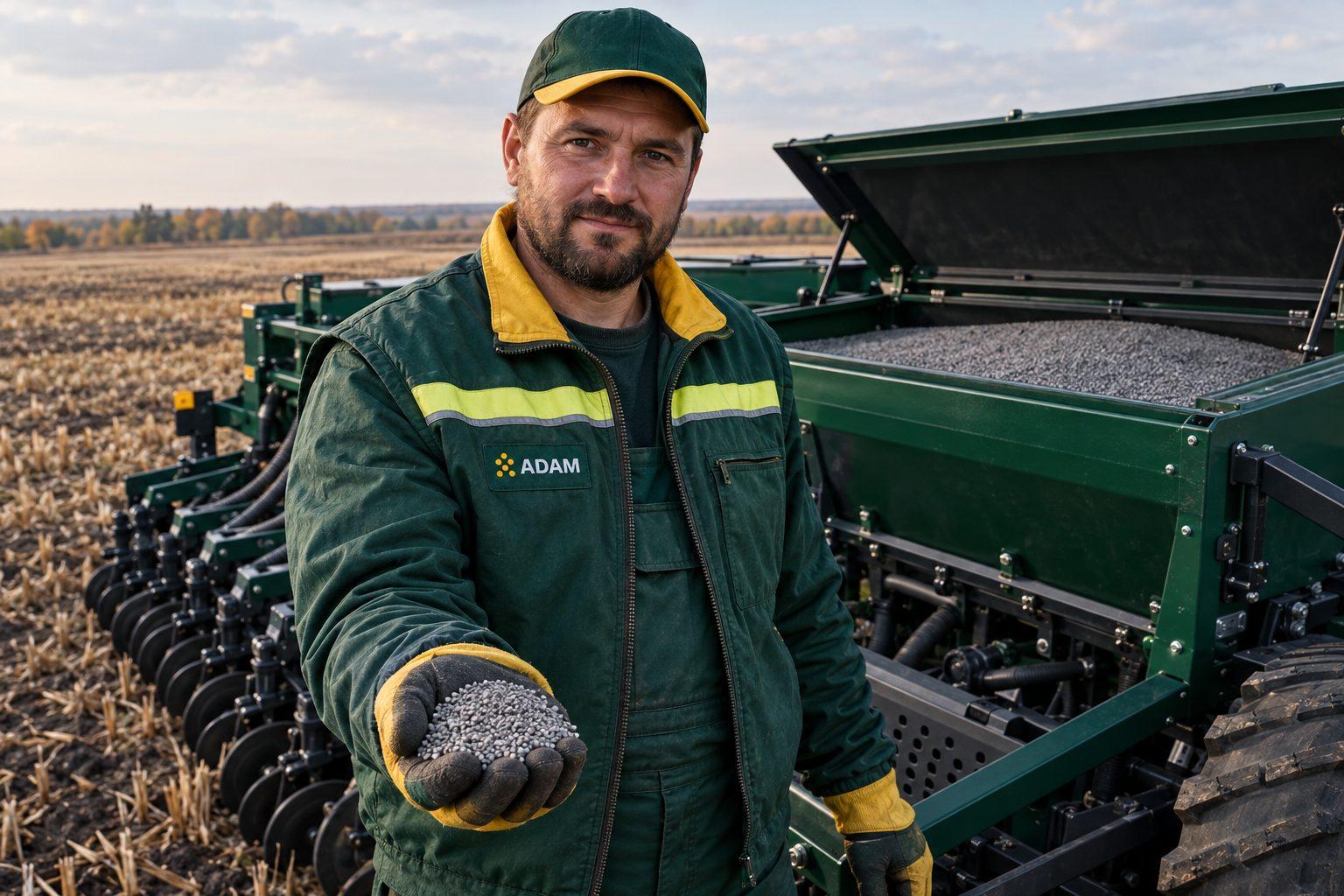
Single and triple superphosphate: what is in it, when and how much to apply per hectare, why it never fully dissolves and how to spot NP 10:32.
Superphosphate is a phosphorus fertiliser for the soil. Single superphosphate carries about 20% P₂O₅, calcium and sulphur, and almost half its weight is gypsum: hence the residue in the bucket. Triple carries 42-50% P₂O₅. On fields it goes under the main tillage, best in autumn, with 7-20 kg/ha P₂O₅ in the row at sowing.
Superphosphate is a phosphorus fertiliser that goes into the soil. Single superphosphate carries about 20% P₂O₅ (19.5% on the Siarkopol label) together with calcium and sulphur, and almost half its weight is gypsum: it is the gypsum that stays behind as a grey residue in a bucket of water. Triple superphosphate, sold in Ukraine as «подвійний» (double), carries 42-50% P₂O₅ and almost no sulphur. On a farm, superphosphate is worked into moist soil under the main tillage, best in autumn, and 7-20 kg of P₂O₅ a hectare goes in the row at sowing. The Myronivka Wheat Institute of NAAS (the National Academy of Agrarian Sciences of Ukraine) and the agrochemistry textbook rate an in-season superphosphate top dressing as of little effect and not worthwhile. A bag of «double superphosphate» that lists 9-10% nitrogen holds a nitrogen-phosphorus fertiliser such as NP 10:32: the label decides, not the name.
What superphosphate is
Single, or granulated, superphosphate is made by treating phosphate rock and apatite with sulphuric acid. H. M. Hospodarenko's agrochemistry textbook (2013) writes it as Ca(H₂PO₄)₂·H₂O + H₃PO₄ + 2CaSO₄·2H₂O: monocalcium phosphate, a little free phosphoric acid and gypsum. Gypsum makes up to 50% of the fertiliser; a 2001 review by the US Department of Agriculture, citing the Merck Index, gives about 45%.
The Grupa Azoty Siarkopol label for single granulated superphosphate (2025) declares 19.5% total P₂O₅, 17.0% of it water-soluble, plus 30% CaO and 32% SO₃, which is 12.8% sulphur (calculation). The textbook gives 19-21% P₂O₅, of which no more than 2.3% is free phosphoric acid, the source of the fertiliser's typical smell.
In ammoniated superphosphate the free acid is neutralised with ammonia. Sumykhimprom's technical sheet (2018) gives it 3 ± 1% nitrogen and 18 ± 1% P₂O₅ in the higher grade, 2 ± 1% and 16 ± 1% in the first grade. Catalogue section: phosphorus fertilisersa.
Single or triple: the difference
| Property | Single | Triple («подвійний») |
|---|---|---|
| Total P₂O₅ | 19.5% (label); 19-21% (textbook) | 42-50% by grade: A 49 ± 1%, B 46 or 43% |
| Water-soluble share of the phosphorus | 17.0 of 19.5%, i.e. 87% (calculation) | over 90% (IPNI); 85-95% (Kansas State University) |
| Sulphur | SO₃ 32%, i.e. S 12.8% | almost none |
| Calcium | CaO 30%, i.e. Ca 21% (calculation) | Ca 13-15% (IPNI) |
| Appearance | granules 1-4 mm, dark grey from phosphate rock or light grey from apatite | larger, more even and darker granules |
«Подвійний» (double) in Ukrainian and «двойной» in Russian are the names of the product that English calls triple superphosphate (TSP, 0-46-0). The methodical guidelines of the Boyarka college of NUBiP (the National University of Life and Environmental Sciences of Ukraine) call superphosphate with over 50% available P₂O₅ «потрійний» (triple).
Which one suits depends on the field. Triple carries more than twice the phosphorus per kilogram (46 against 19.5%), while single adds sulphur. The textbook writes that triple does worse than single on crops that respond well to sulphur, such as brassicas and clover; IPNI puts the advantage of single superphosphate, where it occurs, down mostly to sulphur or calcium.
Read the bag: when «подвійний» (double) is NP 10:32
As of November 2026, Ukrainian listings under the name «суперфосфат двойной» (double superphosphate) sometimes carry a different fertiliser: «NP 10:32», «P 30%, N 9%, S 9%» or «N 10, P 32, S 20, Ca 10». The textbook's triple superphosphate contains no nitrogen. Check four lines on the label:
- <strong>Total P₂O₅.</strong> For triple superphosphate it is 42-50%. Check that the phosphorus is stated as P₂O₅: that is how the Siarkopol label and the Sumykhimprom sheet give it.
- <strong>Water-soluble P₂O₅.</strong> In Siarkopol's single superphosphate it is 17.0 of 19.5%; ammoniated products may have less.
- <strong>Nitrogen (N).</strong> 9-10% means a nitrogen-phosphorus fertiliser, not triple superphosphate.
- <strong>Sulphur (S or SO₃).</strong> 32% SO₃ is 12.8% S (calculation): compare in the same units.
The difference is real: 32% P₂O₅ against 46% is about 30% less phosphorus in every kilogram, and 100 kg of such a fertiliser adds 10 kg of nitrogen that the fertiliser plan may not have counted (calculation).
What superphosphate does and where it pays off
A crop needs available phosphorus from its first days. S. M. Kramarov and S. V. Frolov (Dnipro State Agrarian and Economic University, 2025) write that the phosphorus stored in a wheat seed lasts 7-14 days depending on seed size, and the first roots cannot yet take phosphorus from the soil's solid phase; a shortage at the start cannot be made up in later stages.
Hospodarenko's textbook ranks crops by how reliably phosphorus fertilisers raise their yield on phosphorus-poor soils: very high for winter wheat and sugar beet, high for peas, lucerne, maize and rapeseed, medium for sorghum, soybean and sunflower, low for millet. In trials by the Institute of Grain Crops of NAAS, winter wheat after black fallow in dry years gained yield practically only from phosphorus fertilisers, 0.31 t/ha.
The textbook allows single superphosphate for all crops and on all soil types, and with the phosphorus the crop gets sulphur. Where both nutrients are short, it supplies both (IPNI).
When: under the main tillage, best in autumn
The Institute of Grain Crops of NAAS (2021) writes that in the dry Steppe the main application of mineral fertilisers is most effective in autumn under the main tillage. For sunflower, the textbook advises phosphorus and potassium fertilisers under the autumn ploughing.
The Siarkopol label and the Dnipro agrochemists give a depth of 15-20 cm in the moist layer, the textbook 12-25 cm. Under pre-sowing cultivation the fertiliser lands at 5-6 cm, and when that layer dries out the nutrients become unavailable (Kramarov and Frolov, 2025). For sorghum, the Institute of Grain Crops calls spring application under cultivation less effective precisely because the top layer dries out.
Autumn does not win because the phosphorus “ripens” over winter. In the ³²P trials the textbook cites, about half of the phosphorus mixed evenly with soil is absorbed within two hours, and superphosphate applied a year before sowing worked as well as one applied just before it. On acid soils the textbook advises placing superphosphate locally before or at sowing, because there it quickly turns into poorly soluble forms; see soil pHa.
In the row at sowing
The textbook calls a starter, in-row applicationa of 7-20 kg/ha P₂O₅ mandatory on all soil types; the Institute of Grain Crops of NAAS gives 15-20 kg/ha for all crops. That is 36-103 kg of single superphosphate or 15-43 kg of triple (calculation). The low phosphorus content of single superphosphate makes it possible to drill even 10-15 kg/ha P₂O₅ evenly in the rows.
The granules go 2-3 cm to the side of the seed and 4-5 cm below it, no farther than 5 cm, or the starter effect is lost (Kramarov and Frolov, 2025). Maize and sunflower seed suffers from contact with the fertiliser, so a layer of soil has to separate them and the dose is kept to a minimum.
Hospodarenko reports that 100 kg/ha of granulated superphosphate in the row raises cereal yields by 0.5-0.6 t/ha, and broadcast by only 0.1-0.2 t/ha. If the main dose is placed locally at sowing, the Myronivka institute cuts it by 30-50%.
Rates per hectare by crop
The institutes and the textbook give rates in kilograms of P₂O₅; the table converts them to product: single superphosphate at 19.5%, triple at 46%.
| Crop and method | P₂O₅, kg/ha | Single, kg/ha | Triple, kg/ha |
|---|---|---|---|
| All crops, in the row at sowing (textbook) | 7-20 | 36-103 | 15-43 |
| Winter wheat, seed crops, main application (Myronivka) | 60-120 | 308-615 | 130-261 |
| Winter wheat, seed crops, in the rows (Myronivka) | 10-15 | 51-77 | 22-33 |
| Maize, Steppe, in autumn (Institute of Grain Crops) | 45 | 231 | 98 |
| Maize, Steppe, at sowing (Institute of Grain Crops) | 10-15 | 51-77 | 22-33 |
| Sunflower, in the row as superphosphate (textbook) | 15-30 | 77-154 | 33-65 |
The Siarkopol label for single superphosphate gives its own guide doses of product by soil phosphorus level: spring cereals 210-350 kg/ha, winter cereals 250-390, rapeseed 300-400, beet 350-450, potato 180-300, maize 300-450, legumes 200-300. These are the maker's recommendations for its own product.
A soil test sets the rate
The thresholds for available phosphorus differ slightly between two sources, so both are given as they stand:
- <strong>Institute of Grain Crops, NAAS (2021), after Chirikov:</strong> at 101-150 mg/kg the phosphorus rate is cut by 30%; at 151-200 mg/kg, application at sowing is enough.
- <strong>Hospodarenko's textbook (2013):</strong> the main rates go to soils with less than 100 mg/kg; at 100-150 mg/kg phosphorus goes in the rows for the most valuable crops (winter wheat, maize, grain legumes, rapeseed, sugar beet, flax); at 150 mg/kg and above, phosphorus fertilisers can be skipped for several years. The textbook does not name the test method on that page.
In the year of application, crops use only part of the phosphorus: 20-25% on average, with the rest turning into bound compounds (Myronivka institute), or usually less than 30% (Kansas State University). For the main application the textbook gives 40 to 120 kg/ha P₂O₅ depending on the crop.
Why not a top dressing during the season
The Myronivka Wheat Institute of NAAS (2023) writes that moving phosphorus and potassium fertilisers into in-season top dressing, as ammophos or superphosphate and potassium salt, is of little effect. In season, the institute allows readily water-soluble monopotassium phosphate, dipotassium phosphate and liquid complex fertilisers; for the first, see the guide to monopotassium phosphatea.
Hospodarenko's textbook considers moving part of the phosphorus from the main application into top dressing not worthwhile, even in readily available forms. It makes an exception for row crops: water-soluble phosphorus at inter-row cultivation pays off only when the main application was too small.
The reason is how little phosphorus moves. It travels no more than 1 cm a year down the soil profile (Kramarov et al., 2021), usually reaches a root from no farther than 6 mm in heavy and medium soils and up to 2.5 cm in light ones (Kansas State University), and a root hair takes it up from about 1 mm away (Kramarov and Frolov, 2025).
Why superphosphate “does not dissolve”
The grey residue in the bucket is mostly gypsum, not phosphorus. Single superphosphate is 45-50% gypsum, and gypsum dissolves at only about 2 g a litre (IPNI: 2.05 g/L). Dissolving the 45-50 g of gypsum in 100 g of fertiliser would take 22-24 L of water (calculation).
The phosphorus itself is mostly water-soluble: the Siarkopol label declares 17.0% water-soluble P₂O₅ out of 19.5% total, which is 87% (calculation). In triple superphosphate the water-soluble share is 85-95% (Kansas State University; IPNI: over 90%).
There is less of it in ammoniated and under-acidulated products. Deep ammoniation turns monocalcium phosphate into dicalcium and tricalcium phosphate (Khatsevych's lecture notes), and Siarkopol's Superphosphate Pro has 12% water-soluble P₂O₅ out of 27%. With such fertilisers, part of the phosphorus stays in the residue too.
The advice to pour boiling water over the fertiliser so that the phosphorus “becomes soluble” finds no support in this page's sources: the label already states the water-soluble share. The NUBiP college writes only that triple superphosphate granules dissolve more easily in warm water.
The “extract”: a garden technique
Ukrainian agrochemistry does not advise dissolving superphosphate for fields. Hospodarenko's textbook calls foliar phosphorus feeding economically unjustified: the solutions have to be weak so as not to scorch the leaves, and in production they are hardly used, except together with other agrochemicals and pesticides.
S. M. Kramarov and co-authors (Ahronom journal, 2021) explain what happens if ammophos or triple superphosphate is dissolved and the solution put into the soil: the phosphorus instantly binds with the soil's divalent and trivalent metals into an insoluble compound, so “we deliberately made it worse by dissolving it in water”. Kansas State University writes that liquid or dry application does not change phosphorus use.
Published extract recipes differ more than 100-fold: from about 1.5 to 200 g of fertiliser per litre of finished solution (calculation). None of the labels or institute recommendations we read gives an extract rate, so we give none. For the vegetable garden the label gives a dry rate, covered in the next section; weigh the fertiliser rather than measuring it in spoons.
In the garden: where the rate differs
The Siarkopol garden label for single superphosphate (2025) gives 0.15-0.4 kg per 10 m², which is 15-40 g/m², or 150-400 kg/ha (calculation), close to the field doses on the Siarkopol label. For vegetables the whole dose goes on in spring, mixed into the soil to a depth of 15-20 cm. Lawns, conifers, fruit trees and bushes are fed in autumn or in early spring before growth starts. At sowing the fertiliser can go on together with nitrogen fertilisers, potassium salt and potassium sulphate.
Tomatoes and garlic count as vegetables and raspberries as fruit bushes: the label gives no separate rates for them. The per-bush or per-hole rates found on shop pages and in videos have no source among the labels and institutes, so they are not given here.
What it can and cannot be mixed with
The NUBiP college guidelines advise against mixing superphosphate with lime, chalk, dolomite and wood ash; Hospodarenko's textbook lists retrogradation of phosphorus into an unavailable form among the results of a poor mix. On dolomite the sources disagree: according to the textbook, 10-15% dolomite meal is added to mixes of superphosphate with ammonium nitrate and potassium chloride to neutralise the free acid.
- <strong>Ammonium nitrate:</strong> only in dry weather, right before application. A mix made in advance forms hygroscopic calcium nitrate, turns into a sticky mass and loses nitrogen as oxides.
- <strong>Urea:</strong> shortly before application; the mix releases water of crystallisation.
- <strong>Ammonium sulphate:</strong> the textbook's table allows it, but its own text describes the mix heating up and setting hard, and the NUBiP college advises against it; mix it right before application.
- <strong>Potassium chloride, potassium sulphate, ammophos, diammophos:</strong> yes.
So the claim that superphosphate is incompatible with nitrogen fertilisers and loses its effect is inaccurate: it is about a mix made in advance, and the Siarkopol label allows superphosphate to go on at sowing together with nitrogen fertilisers.
What can replace superphosphate, and whether to take nitroammophoska
100 kg of single superphosphate supplies 19.5 kg of P₂O₅, 12.8 kg of sulphur and about 21 kg of calcium, with no nitrogen or potassium. The same amount of P₂O₅ comes from:
| Fertiliser | kg for 19.5 kg of P₂O₅ | What else it supplies | Valid register entry |
|---|---|---|---|
| Triple superphosphate 46% | 42 | calcium; almost no sulphur | none |
| MAP (ammophos) 11-52 | 37.5 | 4.1 kg of nitrogen | yes |
| DAP (diammophos) 18-46 | 42 | 7.6 kg of nitrogen | yes |
| NPK 16-16-16 | 122 | 19.5 kg of nitrogen and 19.5 kg of K₂O; the registered grade (+25% SO₃) another 12.2 kg of sulphur (calculation) | yes (А 08062) |
Phosphate rock meal (19-30% phosphorus according to the textbook) is used only in the main application. MAPa and DAPa supply nitrogen along with the phosphorus, and it has to be counted in the nitrogen plan.
Nitroammophoska is not a substitute but a different fertiliser: 100 kg of NPK 16-16-16 supplies 16 kg each of nitrogen, P₂O₅ and K₂O. What suits the field is decided by a soil test and the nitrogen plan; more in the guide to nitroammophoskaa. The textbook allows mixing superphosphate with nitroammophoska shortly before application.
Registration and the price per kilogram of P₂O₅
As of November 2026, the public file of the State Register of Pesticides and Agrochemicals (published by the Ministry of Economy on 20.10.2026, newest entry dated 24.06.2024) holds no valid superphosphate entry. Both superphosphate entries in it have expired; the entry for Sumykhimprom's granulated superphosphate (А 02636) was valid until 31.12.2018. It does hold valid entries for ammophos (MAP) and diammophos (DAP). Check the number on the pack against the current register. Last checked 11.11.2026.
Compare prices per kilogram of P₂O₅: divide the price of a kilogram of product by its P₂O₅ share. A bag at 46% gives P₂O₅ no dearer than a bag at 19.5% as long as a kilogram costs no more than 2.36 times as much; NP 10:32 does so up to 1.64 times, and it adds nitrogen as well (calculation). As of November 2026, ADAM's catalogue has one superphosphate, an ammoniated one, with no offers on it. The fertiliser cost calculatora works out the cost per hectare.
Common mistakes
- <strong>Spreading it on ploughland and not working it in.</strong> The label advises mixing it into the soil to 15-20 cm; it is left on the surface only on meadows and perennial plantings.
- <strong>Top-dressing with superphosphate during the season.</strong> The Myronivka institute rates it as of little effect.
- <strong>Mixing it with ash, lime or chalk.</strong>
- <strong>Dissolving it for the field.</strong> The soil binds dissolved phosphorus instantly.
- <strong>Buying «подвійний» (double) by the name.</strong> Look at the nitrogen line on the label.
- <strong>Placing maize or sunflower seed on the granules.</strong>
- <strong>Expecting the phosphorus to “ripen” over winter.</strong> About half of the phosphorus mixed with soil is absorbed within two hours.
How we checked this. The text was prepared with AI help from ADAM's research notes. On 11 November 2026 a separate check, also AI-assisted, reopened the Siarkopol labels, the Sumykhimprom sheet, Hospodarenko's textbook, the recommendations of two NAAS institutes and the public file of the State Register, and compared every number with them; each source's date is given in the text or in the source list. Figures marked “calculation” were recalculated.
Sources
- State Register of Pesticides and Agrochemicals, Ministry of Economy public file of 20.10.2026 (newest row 24.06.2024), read 11.11.2026 · me.gov.ua
- Grupa Azoty Siarkopol: product catalogue, agricultural fertilisers 2025, Ukrainian edition, simple granulated superphosphate and Superphosphate Pro labels (PDF 04.12.2025) · zchsiarkopol.pl
- Grupa Azoty Siarkopol: product catalogue, garden fertilisers 2025, Ukrainian edition, simple superphosphate label (PDF 07.12.2025) · zchsiarkopol.pl
- Sumykhimprom: technical sheet, granulated ammoniated superphosphate (01.01.2018) · sumykhimprom.com.ua
- Hospodarenko: Agrochemistry, university textbook, Kyiv, Ahrarna osvita (2013), pp. 57, 119-126, 149-151, 309 · learn.zhatk.zt.ua
- Institute of Grain Crops, NAAS: crop growing under climate change in 2021, recommendations for the Steppe, Dnipro (PDF 01.02.2021), pp. 19, 44, 50 · market.institut-zerna.com
- Remeslo Myronivka Wheat Institute, NAAS: technology of growing winter wheat seed, methodical recommendations (2023), p. 18 · mip.com.ua
- Kramarov and Frolov (Dnipro State Agrarian and Economic University): row fertilisation and available phosphorus for winter wheat, conference theses (2025), pp. 148-151 · dspace.mnau.edu.ua
- Kramarov, Bandura (Dnipro State Agrarian and Economic University) and Kramarov (Institute of Grain Crops, NAAS): liquid complex fertilisers compared with solid ones, Ahronom no. 1 (February 2021), pp. 22-26 · dspace.dsau.dp.ua
- Kansas State University Research and Extension: C665 Phosphorus Facts, Soil, Plant, and Fertilizer (PDF 22.05.2017) · bookstore.ksre.ksu.edu
- IPNI: Nutrient Source Specifics No. 21, single superphosphate (Spanish edition hosted by IFA, PDF 06.08.2013) · fertilizer.org
- IPNI: Nutrient Source Specifics No. 14, triple superphosphate (Spanish edition hosted by IFA, PDF 06.08.2013) · fertilizer.org
- IPNI: Nutrient Source Specifics No. 16, gypsum (Spanish edition hosted by IFA, PDF 06.08.2013) · fertilizer.org
- USDA National Organic Standards Board: TAP review, Triple Superphosphate (June 2001) · ams.usda.gov
- Khatsevych (Vasyl Stefanyk Precarpathian National University): Chemistry of mineral fertilisers, lecture notes (approved 24.01.2018) · kc.cnu.edu.ua
- Yevpak et al., Boyarka professional college of NUBiP: methodical guidelines on identifying mineral fertilisers by appearance and qualitative reactions (2026) · dglib.nubip.edu.ua
Frequently asked questions
What is in superphosphate?
Single superphosphate consists of monocalcium phosphate Ca(H₂PO₄)₂·H₂O, a small amount of free phosphoric acid and gypsum, which makes up to 50% of the fertiliser. The Siarkopol label declares 19.5% P₂O₅ (17.0% of it water-soluble), 30% CaO and 32% SO₃. Triple superphosphate carries 42-50% P₂O₅ and almost no sulphur.
When should superphosphate be applied?
On a field, under the main tillage, best in autumn, worked into the moist layer at 15-20 cm, and in the row at sowing at 7-20 kg/ha P₂O₅. The Myronivka Wheat Institute of NAAS rates an in-season superphosphate top dressing as of little effect. In the garden, the label advises putting the whole dose for vegetables on in spring, and for lawns, conifers and fruit plantings in autumn or early spring.
What can be fed with superphosphate?
Superphosphate goes into the soil before or at sowing. The Myronivka institute of NAAS rates moving phosphorus into top dressing as of little effect and the agrochemistry textbook as not worthwhile, with an exception for row crops that got too little in the main application. The textbook allows superphosphate for all crops on all soil types; the garden label names vegetables, lawns, conifers, fruit trees and bushes. In season, the institute allows readily soluble monopotassium phosphate, dipotassium phosphate and liquid complex fertilisers.
How much superphosphate per 10 L of water?
None of the labels or institute recommendations we read gives a rate for a solution, and published recipes differ more than 100-fold. Superphosphate is meant to go into the soil: the Siarkopol garden label gives 15-40 g per square metre, worked in to 15-20 cm. The grey residue in the bucket is mostly gypsum, about half of the fertiliser.
How much superphosphate for tomatoes?
The label gives no separate rate for tomatoes: they count as vegetables, for which the Siarkopol garden label states 0.15-0.4 kg per 10 m², which is 15-40 g/m², the whole dose in spring, mixed in to 15-20 cm. Per-bush rates from shop pages and videos have no source among the labels and institutes.
What does superphosphate cost?
As of November 2026, ADAM's catalogue has no superphosphate offers, so we give no price. Compare offers per kilogram of P₂O₅: divide the price of a kilogram by the P₂O₅ share on the label. Triple (46%) gives P₂O₅ no dearer than single (19.5%) as long as a kilogram costs no more than 2.36 times as much; single, in return, adds sulphur.
What is triple superphosphate for?
The same as single: phosphorus for the main application and for the row at sowing. It carries 42-50% P₂O₅ against 19.5% in single, so it takes less than half as much product, but it has almost no sulphur. If a bag sold as «подвійний» (double) lists 9-10% nitrogen, it is not triple superphosphate but a nitrogen-phosphorus fertiliser such as NP 10:32.