
Ammonium nitrate: what it is for, when to apply, rates, storage
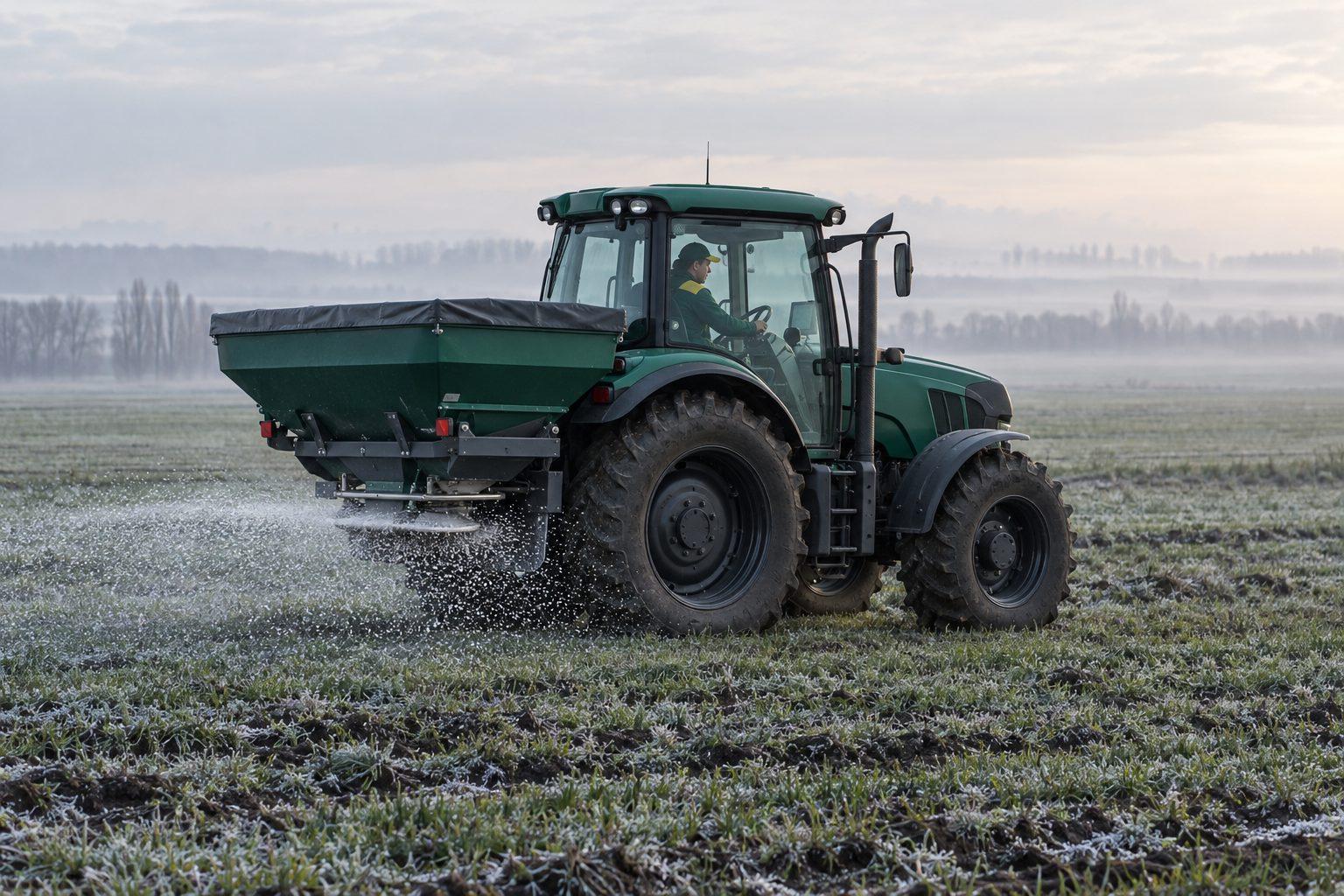
Ammonium nitrate, 34.4% N: what it is for, when and how much to apply to winter wheat per NAAS, storage under Order No. 775-21, the 2025 price.
Ammonium nitrate (NH₄NO₃) is a nitrogen fertiliser with 34.4% nitrogen, half of it nitrate. NAAS institutes give winter wheat its first dose on frozen-thawed soil, mainly to weak and thinned crops: 20-60 kg N/ha (58-174 kg of fertiliser). It needs no registration; storing 500 kg or more falls under Ministry of Economy Order No. 775-21.
Ammonium nitrate (аміачна селітра, NH₄NO₃) is a granular nitrogen fertiliser with 34.4% nitrogen, 34% in the second grade. Half of its nitrogen is nitrate, which the crop takes up at once, and half is ammonium. Farms apply it mostly in spring: institutes of the National Academy of Agrarian Sciences of Ukraine (NAAS) give the first dose to weak and thinned winter wheat on frozen-thawed soil, 20-60 kg of nitrogen a hectare, that is 58-174 kg of fertiliser, and move it to the end of tillering for well-tillered crops. As of 11.11.2026 it needs no state registration, and a business or farm storing 500 kg or more follows Ministry of Economy Order No. 775-21: never loose in the open, and at least 5 m from hay, straw, grain and feed or behind a barrier of inert material at least 1.5 m wide.
What ammonium nitrate is
Ammonium nitrate, in Ukrainian also нітрат амонію or азотнокислий амоній, is the salt NH₄NO₃. The Law «On Pesticides and Agrochemicals» calls it «Аміачна селітра (нітрат амонію)», ammonium nitrate; in Russian it is «аммиачная селитра» or «нитрат аммония». The textbook «Agrochemistry» (Hospodarenko, 2013) gives 34.4% nitrogen, 34% in the second grade, and the entries in the State Register had 34.0-34.4%. The molecule has one ammonium ion and one nitrate ion, so the nitrogen splits in half (calculation).
It comes as white granules: according to the State Service on Food Safety and Consumer Protection (Derzhprodspozhyvsluzhba) in Kherson oblast (2020), 90% of the granules are 1-3 mm. It absorbs moisture and cakes, and when the granules are heated above 32.2 °C and cooled again many times, they break down into dust (Order No. 775-21). It is physiologically acidic: neutralising a tonne of ammonium nitrate takes about 0.6-0.75 t of lime (Hospodarenko, 2013; Cornell University, calculation). DSTU 7370:2026 has applied since 01.08.2026, and DSTU 7370:2013 is cancelled from 01.02.2027. Catalogue section: ammonium nitratea.
Forms on sale: ammonium nitrate, CAN and other grades
Calcium ammonium nitratea (CAN, in Ukrainian ВАС) is ammonium nitrate with calcium carbonate: grade A has 25-28% nitrogen, grade B 20-24% (Hospodarenko, 2013). Rivneazot's CAN entry in the register, valid until 31.12.2025, gave N 20-28%, CaO 4-22% and MgO 6%, so CAN also comes with magnesium. There are grades with sulphur: Saletrosan 26 plus (Grupa Azoty) has 26% nitrogen, 7.3% of it nitrate, and 32.5% SO₃, that is 13% sulphur (calculation). Check the nitrogen share of each grade on the label.
In March 2026 Ostchem announced a grade called «АМС30» with 30% nitrogen (Forbes.ua, 31.03.2026). This is the company's statement; we found no technical specification for it.
The rate is set in nitrogen, so for CAN it is divided by the grade's nitrogen share: 30 kg of nitrogen is 111 kg of 27% CAN or 87 kg of 34.4% ammonium nitrate (calculation). Ammonium sulphate is not a selitra: it contains no nitrate, but 21% ammonium nitrogen and 24% sulphur.
Other nitrates: calcium, potassium, sodium
Other nitrates are called selitra (селітра) too. Below are their composition and crops from the valid entries of the State Register of Pesticides and Agrochemicals as of November 2026; the entries give no rates for calcium nitrate.
| Fertiliser, entry | Composition in the register | Registered for |
|---|---|---|
| Calcium nitrate, Yara, А 07566 (to 2029) | N 15.5%, CaO 26.5% | open-field cucumbers and tomatoes, no rate given |
| Calcium nitrate Solucalcium, А 06961 (to 2028) | N 15.5%, CaO 26-27.5% | protected vegetables, flowers, no rate given |
| Potassium nitrate: Yara, А 06698 (to 2027); Ultrasol, А 08745 (to 2030) | N 13.8%, K₂O 46.3% (Yara); N 12-14%, K₂O 45-47% (Ultrasol) | Ultrasol: cereals, industrial crops, vegetables, maize, basal application 50-100 kg/ha once; cereals, industrial crops, maize foliar 1-5 kg/ha three times; vegetables foliar 1-5 kg/ha four times, fertigation 5-20 kg/ha four times |
| Sodium nitrate, А 10281 (to 2033) | N 16.2%, Na 26.6% | protected cucumbers, 50-100 kg/ha once |
Calcium nitrate supplies nitrogen and calcium, and potassium nitrate supplies nitrogen and potassium. Calcium nitrate is not put in one tank with phosphates such as monopotassium phosphate: calcium and phosphate form insoluble calcium phosphate (Haifa; Purdue University, 2017). More detail is in the guide to monopotassium phosphatea.
What it is applied for, and to which crops
Ammonium nitrate gives crops nitrogen for growth, and in spring its nitrate half is what matters. The V. Ya. Yuriev Plant Production Institute of NAAS (2023) recommends ammonium nitrate specifically for the first top-dressing on frozen-thawed soil, because it dissolves quickly and nitrate nitrogen is taken up at once; it calls the nitrate form irreplaceable in the first top-dressing. The Institute of Grain Crops of NAAS (2021) also prefers forms with nitrate nitrogen. The Myronivka Wheat Institute of NAAS (2023), in its guidelines for seed crops, writes that in the first top-dressing ammonium nitrate remains traditional for many farms, and in the second nitrogen is applied mainly as ammonium nitrate.
The institutes give rates of ammonium nitrate itself for winter wheat and winter rapeseed; nitrogen rates for spring cereals, maize and sunflower are below. The last ammonium nitrate entries in the State Register, no longer valid, named cereals, maize, industrial and fodder crops, potatoes, vegetables and fruit crops. For a garden, convert the per-hectare rate like this: 1 kg a hectare is 0.1 g a square metre (calculation).
Winter wheat: when to apply
NAAS institutes group crops by their condition after winter. Weak and thinned crops are top-dressed on frozen-thawed soil before growth resumes, to push spring tillering (Yuriev Plant Production Institute, 2023; Institute of Agriculture of the Steppe, 2023). On well-tillered crops, according to the Yuriev Institute, early nitrogen can cause extra tillering and unproductive shoots, so their first top-dressing is moved to the end of tillering or the start of stem elongation and applied locally, with grain drills.
For seed crops the Myronivka Wheat Institute (2023) sets shares of the full nitrogen rate: the first top-dressing on frozen-thawed soil 25-30%, the second at the start of stem elongation 45-60%. A top-dressing is needed if the plough layer holds less than 8-10 mg/kg of nitrates or the leaves less than 4.9% nitrogen.
Winter wheat: how much to apply
The rates of the four institutes differ by zone and crop condition. In the table nitrogen is converted to kilograms of ammonium nitrate with 34.4% nitrogen: kg of nitrogen ÷ 0.344 (calculation).
| Institute, zone, year | Situation | kg N/ha | kg ammonium nitrate/ha |
|---|---|---|---|
| Myronivka Wheat Institute, central Forest-Steppe, 2023, seed crops | first top-dressing on frozen-thawed soil; second at the start of stem elongation | 25-30% and 45-60% of the full rate | from the farm's full rate |
| Yuriev Plant Production Institute, Kharkiv oblast, 2023 | weak crops on frozen-thawed soil, or tillered crops at the end of tillering with drills: after good preceding crops / after sunflower, grain maize, stubble crops | 30-40 / 40-50 | 87-116 / 116-145 |
| Institute of Agriculture of the Steppe, Kirovohrad oblast, 2023 | with early regrowth: thinned, weak and medium crops as early as possible / developed crops at the end of spring tillering with drills | 20-30 / 35-45 | 58-87 / 102-131 |
| Institute of Grain Crops, Steppe, 2021 | by plant density, stage and regrowth date: on frozen-thawed soil / locally at the end of tillering | 30-60 / 30-75 | 87-174 / 87-218 |
These are the doses of one top-dressing. The full nitrogen rate for the season is calculated from the planned yield and the soil's nitrogen supply; the nitrogen rate calculatora does this. For intensive varieties the Yuriev Institute splits it like this: 25-30% in the first dose, 55-60% in the second.
Winter wheat: what the trials showed
In 2017-2019 the Institute of Grain Crops of NAAS compared top-dressings of winter wheat on chernozem. One N30 dose on frozen-thawed soil added 0.30-0.43 t/ha after black fallow and 0.20-0.31 t/ha after sunflower. Two doses of N30, the second applied locally at the end of tillering, gave 0.66-0.82 and 0.53-0.74 t/ha. UAN-32 gave the largest gains in the trial. Class 2 grain came only with two doses, and after sunflower only with UAN-32 and ammonium sulphate.
Delay has a price too: when top-dressing was put off by 10-15 days, the average gain over five years fell from 0.35 to 0.21 t/ha. At the Yuriev Institute, ammonium nitrate and urea worked in locally performed almost the same (2023). The Institute of Agriculture of the Steppe (2023) writes that top-dressing on frozen-thawed soil raises tillering and yield but has little effect on grain quality; quality comes from later foliar top-dressings, from heading to grain filling.
Autumn: the rate the shops print
A line repeated online reads «Озимі зернові: 200-360 кг на 1 га, восени» (winter cereals: 200-360 kg per hectare, in autumn), which equals 69-124 kg of nitrogen (calculation). It has no source. For winter wheat in autumn the sources give several times less: the Myronivka Wheat Institute (2023, seed crops) applies 25-30 kg of nitrogen at pre-sowing cultivation, ammonium nitrate among the forms, that is 73-87 kg of fertiliser (calculation). The textbook «Agrochemistry» (Hospodarenko, 2013) gives 20-30 kg of nitrogen where the plough layer holds less than 20 mg/kg of mineral nitrogen. Neither advises applying ammonium nitrate in autumn on heavy soils.
The textbook names an autumn top-dressing with ammonium nitrate itself for weak winter rapeseed: no later than the first ten days of October, 20-30 kg of nitrogen a hectare, that is 58-87 kg of ammonium nitrate (calculation), or a foliar spray of 8-10% urea solution. We saw the Yuriev Institute's autumn trial (2024) only as an abstract, so its figures are not given here.
Winter rapeseed
The Yuriev Plant Production Institute (2023) gives rapeseed its first top-dressing at the start of regrowth, 40-100 kg of nitrogen a hectare, that is 116-291 kg of ammonium nitrate (calculation). Ammonium nitrate, urea or UAN suit it. The second, 40 kg of nitrogen, goes on at the large-bud stage and no later than flowering, preferably as ammonium sulphate. Weak or thinned crops with fewer than 40-50 plants per square metre get another 20 kg of nitrogen, that is 58 kg of ammonium nitrate (calculation).
In the textbook «Agrochemistry» (Hospodarenko, 2013) the early spring dose is 80-100 kg of nitrogen and the second 40-80 kg 2-3 weeks later, at the start of stem growth. With enough moisture a third top-dressing before flowering is applied specifically with ammonium nitrate, 30-40 kg of nitrogen, that is 87-116 kg of fertiliser (calculation).
Spring cereals, maize, sunflower
For spring wheat the Yuriev Plant Production Institute (2023) recommends a near-root top-dressing of N30-40 at tillering, that is 87-116 kg of ammonium nitrate (calculation). For spring barley it gives N30-60, that is 87-174 kg of ammonium nitrate, 70-75% of it before main tillage; malting varieties get 25-30% less nitrogen. For sunflower N40-80, that is 116-233 kg of ammonium nitrate, with the nitrogen applied in spring before cultivation.
For maize in the Steppe the Institute of Grain Crops of NAAS (2021) gives a guide rate of N60P30K30; if all this nitrogen is given as ammonium nitrate, that is 174 kg a hectare (calculation). The institute considers an early root top-dressing of N15-20 insufficiently effective where moisture is unreliable. We found no source with a rate of ammonium nitrate itself for potatoes, so there is none here.
How to apply it in the field
On farms ammonium nitrate is applied as granules. On frozen-thawed soil centrifugal spreaders do the work, and the Institute of Grain Crops names the NRU-0.5, NRU-0.6 and MVD-900; at the end of tillering the fertiliser goes on locally with grain drills such as the SZ-3.6A-01 or SZ-5.4-01. The effect of a top-dressing weakens when the topsoil dries out (Institute of Grain Crops, 2021). The labour safety rules in agricultural production (NPAOP 01.0-1.02-18) forbid transporting, mixing and applying «ammonia-containing mineral fertilisers» in the dark.
Ammonium nitrate loses little as ammonia, because its nitrate half does not volatilise: by the EMEP/EEA emission factors (2023), about 2% of its nitrogen on soils with pH up to 7 and 4.3% on soils with pH above 7, and in trials losses did not exceed 4%. Urea spread on the surface without incorporation loses 25-30% and more (Yuriev Plant Production Institute, 2023); the article ammonium nitrate or ureaa compares the two. The fertiliser mass is calculated like this: kg of nitrogen ÷ 0.344, so 45 kg of nitrogen is 131 kg of ammonium nitrate (calculation).
Solution: how much per 10 litres
Ammonium nitrate dissolves well: 213 g in 100 g of water at 25 °C and 118 g in 100 ml at 0 °C (PubChem). No Ukrainian source we opened gives concentrations for foliar spraying or watering with ammonium nitrate itself. The Myronivka Wheat Institute recommends foliar nitrogen top-dressing with UAN diluted 1:3 with water, not with an ammonium nitrate solution.
Shop pages give recipes «per 10 L of water» with no source and on different calculation bases, so no such figures are given here. In the field ammonium nitrate is applied as granules and the rate is set in kilograms per hectare; for a garden it is converted to grams per square metre, as shown above. If you make a solution for watering, work it out from that rate, not from a «per bucket» recipe.
Registration and who may buy it
As of 11.11.2026 ammonium nitrate needs no state registration. The Law «On Pesticides and Agrochemicals», in the edition of 15.11.2024 (Article 4), does not apply its registration requirements to the agrochemicals in its annex, and the annex lists ammonium nitrate, mixtures of ammonium nitrate with calcium carbonate, that is CAN, and UAN. The annex was added in 2015 (Law No. 867-VIII).
That is why the State Register holds no valid entry for ammonium nitrate or CAN: the last ones expired between 31.12.2023 and 31.12.2025 (public file of 20.10.2026). The law does not require a state registration number on the label of such agrochemicals (Article 10).
None of the acts we read bans selling ammonium nitrate to private buyers. Agrochemicals are sold to the public only in small packs and with a label (Article 11). Businesses that store, apply or sell agrochemicals insure their liability (Article 11), and businesses keep records of the agrochemicals they hold and use (Article 14). This applies to urea too.
Storing 500 kg or more: Order No. 775-21
As of 11.11.2026 storage is governed by Ministry of Economy Order No. 775-21, in force since 18.05.2021. It applies to businesses storing 500 kg of ammonium nitrate or more. The order's definition of ammonium nitrate has a threshold: nitrate and ammonium nitrogen together of at least 28%. Ammonium nitrate with 34.4% and «АМС30» with 30% are above it, CAN with 27% is below. The order requires:
- no storing ammonium nitrate loose in temporary makeshift stores or on open sites;
- packed product kept in the open for no more than a month, protected from rain and sun;
- in paper bags and loose, storage at up to 30 °C and up to 50% humidity;
- in agriculture, keeping it at least 5 m from stores of hay, straw, grain and feed, or behind a barrier of inert material at least 1.5 m wide;
- separating it from urea in the same building by an aisle for vehicles with 0.5 m to spare for turning, or 1 m when people work in the store;
- no storing beyond the maker's guarantee period.
What must not be kept near ammonium nitrate
The annex to Order No. 775-21 forbids keeping these in one store with ammonium nitrate:
- fuel, lubricants, solvents, hydrocarbon-based pesticides and flammable gases;
- sulphur, fine metal powders, explosives and reducing agents;
- hay, straw, grain, husks, feed, paper, cotton and fertilisers with organic matter;
- cement, lime, basic slag and other alkalis, because ammonia is released with them;
- chlorides, copper, cadmium, chromium, zinc and their salts, hypochlorite, chlorates, nitrites, permanganates.
The order treats potassium, sodium and calcium nitrate, ammonium sulphate, CAN and NPK based on ammonium nitrate as compatible, but they too are kept separately. Pesticides with flammable solvents are not stored in a building with ammonium nitrate or one attached to it. The Fire Safety Rules of Ukraine (Ministry of Internal Affairs order No. 1417) require oxidisers to be kept in separate sections and refer to Order No. 775-21. The labour safety rules in agricultural production (NPAOP 01.0-1.02-18) forbid keeping food, fodder or water in containers from mineral fertilisers, even after decontamination.
Permits, precursors and the EU rule
As of 11.11.2026 none of the acts we read requires a permit from Derzhprodspozhyvsluzhba, the SBU (Security Service of Ukraine) or any other body to buy or store ammonium nitrate, or calls it an explosives precursor. We read the Law «On Pesticides and Agrochemicals», Order No. 775-21, the Fire Safety Rules of Ukraine and the labour safety rules in agricultural production. The old order No. 142 of 01.09.2009 of the State Mining Supervision Service (Derzhhirpromnahliad), with rules for ammonium nitrate in bulk, lost force on 18.05.2021, when Order No. 775-21 came into force.
Law No. 2804-IX on chemical safety provides for a list of dual-use chemicals, but does not apply to pesticides and agrochemicals (Article 3, current edition of 02.03.2026); we did not find the list itself in open data.
In the EU, since 01.02.2021, ammonium nitrate with more than 16% nitrogen from ammonium nitrate is not sold to the general public, and no licences are issued for it (Regulation (EU) 2019/1148, Annex I). Farmers buy it as professional users, and Yara puts its CAN in this group too.
Why ammonium nitrate is dangerous
Ammonium nitrate is an oxidiser and a fire-hazardous substance (Order No. 775-21): it does not burn itself, but it supports burning. It melts at about 170 °C and from 210 °C decomposes, giving off nitrogen(I) oxide (PubChem). Heated to 210 °C, it reacts with sulphur, acids, superphosphate, bleaching powder and metal powders, and the oxygen released ignites combustible materials.
Ammonium nitrate can explode if it is heated in a confined space where the gases have no way out, from a strong impact or a blast wave, or detonate in a large fire; impurities make it more explosive (Order No. 775-21, section VIII). Its smoke contains toxic nitrogen oxides and ammonia (PubChem). Fertilisers are prepared for application with machines fitted with dust control, in work clothing and with respiratory and eye protection (NPAOP 01.0-1.02-18). Applicants for State Register entries declared hazard class 3 or 4 for ammonium nitrate and CAN.
What it costs
According to the State Statistics Service, in 2025 agricultural enterprises paid on average 17,763 UAH per tonne of ammonium nitrate, without VAT, delivered; in 2024 15,517 UAH, in 2023 20,822 UAH. Over the year a tonne rose by about 14% (calculation). This is the average price for the year, not today's: the 2025 data were published on 08.06.2026, and the next data will be out on 08.06.2027.
Agricultural enterprises submit these average prices in their annual report to the State Statistics Service on form 50-сг. A kilogram of nitrogen in ammonium nitrate cost them about 51.6 UAH in 2025 (calculation: 17,763 ÷ 344). Look for sellers' offers in the catalogue section ammonium nitratea; the sellers set the prices there themselves.
Common mistakes
- <strong>A first dose on frozen-thawed soil for a well-tillered crop.</strong> The institutes move it to the end of tillering.
- <strong>A delay of 10-15 days.</strong> In the Institute of Grain Crops' trials it cost two fifths of the gain.
- <strong>An autumn rate of 200-360 kg on winter cereals.</strong> Before sowing the sources give 20-30 kg of nitrogen.
- <strong>Kilograms of fertiliser instead of kilograms of nitrogen.</strong> 50 kg of nitrogen is 145 kg of ammonium nitrate.
- <strong>Ammonium nitrate loose in the open, or bags beside hay, grain, lime or fuel.</strong> Order No. 775-21 forbids this.
- <strong>Fertiliser bags reused for food, feed or water.</strong> The labour safety rules forbid this.
- <strong>A garden dose «per 10 L» in a field sprayer.</strong> Field rates are in kilograms per hectare.
How we checked: every number was checked against a source listed below, and the laws and orders were checked for amendments as of 11.11.2026, including Law No. 4718-IX's amendment to Law No. 2804-IX. The facts were re-checked separately from the writing. The text was prepared with the help of AI. Last checked: 11.11.2026.
Sources
- Law of Ukraine No. 86/95-VR «On Pesticides and Agrochemicals», edition of 15.11.2024 (Art. 4, 11, 14 and the Annex), current on 19.10.2026 · zakon.rada.gov.ua
- Ministry of Economy order No. 775 of 15.04.2021 (Ministry of Justice No. 603/36225): minimum safety requirements for storing and packing ammonium nitrate, in force 18.05.2021, unamended (checked 11.11.2026) · zakon.rada.gov.ua
- Fire Safety Rules of Ukraine, Ministry of Internal Affairs order No. 1417 of 30.12.2014, section VI ch. 9, edition of 27.02.2026 · zakon.rada.gov.ua
- NPAOP 01.0-1.02-18 Labour safety rules in agricultural production, order No. 1240 of 29.08.2018, section IV (unamended) · zakon.rada.gov.ua
- Law of Ukraine No. 2804-IX on chemical safety and chemical products management, 01.12.2022, applies from 29.06.2024; edition of 02.03.2026 (Law 4718-IX changed only Art. 26), Art. 3 and 35 · zakon.rada.gov.ua
- Cabinet of Ministers of Ukraine: procedure for the list of dual-use chemicals approved (news, 28.06.2024) · kmu.gov.ua
- Regulation (EU) 2019/1148 on the marketing and use of explosives precursors, Annex I, applies from 01.02.2021 (no amending act listed on 11.11.2026) · eur-lex.europa.eu
- Yara: Explosives Precursors Regulation, EU public distribution (PDF 07.12.2023) · pre-french-master.yara.fr
- State Register of Pesticides and Agrochemicals, Ministry of Economy public file of 20.10.2026 (newest row 24.06.2024), re-read 11.11.2026 · me.gov.ua
- Budstandart: DSTU 7370:2026 «Ammonium nitrate. Specifications» in force from 01.08.2026 (news, 10.04.2026) · online.budstandart.com
- Hospodarenko: Agrochemistry, textbook (2013), pp. 92-93, 282, 317-318 · learn.zhatk.zt.ua
- Yuriev Plant Production Institute (NAAS): spring field work strategy for Kharkiv oblast, 2023 · yuriev.com.ua
- Institute of Agriculture of the Steppe (NAAS), Tomashyna et al.: care of winter cereals in Kirovohrad oblast in 2023 · dmytrivskaotg.dosvit.org.ua
- Institute of Grain Crops (NAAS): growing field crops under climate change in 2021 (PDF 01.02.2021), pp. 17-18, 30-38 · market.institut-zerna.com
- Remeslo Myronivka Institute of Wheat (NAAS): winter wheat seed production technology, guidelines (2023), pp. 18-19 · mip.com.ua
- PubChem: ammonium nitrate, CID 22985 (melting point, decomposition, solubility, hazards) · pubchem.ncbi.nlm.nih.gov
- State Food Safety Service in Kherson oblast: «Ammonium nitrate: storage conditions» (news, 2020) · dpss-ks.gov.ua
- State Statistics Service: average prices of fertilisers bought by agricultural enterprises, form 50-sg, 2023-2025 (published 08.06.2026) · stat.gov.ua
- Grupa Azoty: «Nasze nawozy azotowe», nitrogen fertiliser folder (PDF 18.09.2023), Saletrosan 26 plus: N 26 %, of it nitrate 7.3 %, SO3 32.5 % · procam.pl
- Forbes.ua: Ostchem announces a new nitrate grade (31.03.2026) · forbes.ua
- EMEP/EEA air pollutant emission inventory guidebook 2023, 3.D Crop production and agricultural soils, Table 3-2 and Table A1.1 (ammonia from ammonium nitrate and CAN by soil pH) · eea.europa.eu
- Cornell NRCCA: competency area 5, soil acidity from nitrogen fertilisers (lime equivalents) · nrcca.cals.cornell.edu
- Guan, Purdue University Cooperative Extension, Vegetable Crops Hotline: Fertilizer Compatibility (07.08.2017) · vegcropshotline.org
- Haifa: How to prepare fertilizer solutions in a two-tank system (undated, read 10.11.2026) · haifa-group.com
Frequently asked questions
What kinds of selitra (nitrate fertiliser) are there?
Nitrates are called selitra. Ammonium nitrate contains 34.4% nitrogen, calcium ammonium nitrate (CAN) 20-28% nitrogen plus calcium carbonate. Calcium nitrate gives 15.5% nitrogen and 26.5% CaO, potassium nitrate 13.8% nitrogen and 46.3% K₂O, sodium nitrate 16.2% nitrogen (State Register entries as of November 2026). Ammonium sulphate is not a selitra: it contains no nitrate.
What is the ammonium nitrate rate for winter wheat?
For one top-dressing NAAS institutes give 20-60 kg of nitrogen a hectare, depending on the zone and the crop's condition, that is 58-174 kg of ammonium nitrate; applied locally at the end of tillering, the Institute of Grain Crops allows up to 75 kg of nitrogen (218 kg of ammonium nitrate). For seed crops the Myronivka Wheat Institute works in shares of the full rate: 25-30% in the first top-dressing, 45-60% at the start of stem elongation.
When is it best to apply ammonium nitrate to wheat?
To weak and thinned crops on frozen-thawed soil, before growth resumes. To well-tillered crops at the end of tillering or the start of stem elongation, locally with drills, because early nitrogen can give them unproductive shoots. The second top-dressing at the start of stem elongation. In the Institute of Grain Crops' trials a delay of 10-15 days cut the gain from 0.35 to 0.21 t/ha.
How much ammonium nitrate is needed per hectare of maize?
The Institute of Grain Crops of NAAS gives maize in the Steppe a guide rate of N60P30K30; if all the nitrogen is given as ammonium nitrate, that is 174 kg a hectare (calculation). The institute considers an early root top-dressing of N15-20 insufficiently effective where moisture is unreliable. The exact rate is calculated from the planned yield and the soil's nitrogen supply.
What are the rates of calcium ammonium nitrate per hectare?
The rate is set in nitrogen, and for CAN it is divided by the grade's nitrogen share: 30 kg of nitrogen is 111 kg of CAN with 27% nitrogen or 87 kg of ammonium nitrate with 34.4% (calculation). As of November 2026 the State Register has no valid CAN entries: like ammonium nitrate, it needs no registration.
Which is better: ammonium nitrate or nitroammophoska?
They are fertilisers for different jobs, and which one you need depends on what the field lacks. Ammonium nitrate supplies nitrogen only, 34.4%. Nitroammophoska is a compound fertiliser: grade 16-16-16 has 16% each of nitrogen, P₂O₅ and K₂O (Hospodarenko, 2013). For spring nitrogen top-dressing of winter wheat NAAS institutes name ammonium nitrate. More in the article on <a href="/en/blog/nitroamofoska">nitroammophoska</a>.
Is ammonium sulphate a selitra or not?
No. Ammonium sulphate contains no nitrate: 21% nitrogen, all of it ammonium, and 24% sulphur. The Law «On Pesticides and Agrochemicals» lists it in its annex separately from ammonium nitrate. It acidifies soil more strongly: about 5.4 kg of CaCO₃ per kilogram of nitrogen, against 1.8 kg for ammonium nitrate (Cornell University).