
7 Best Nitrogen Fertilizers for Ukrainian Winter Wheat (2026)
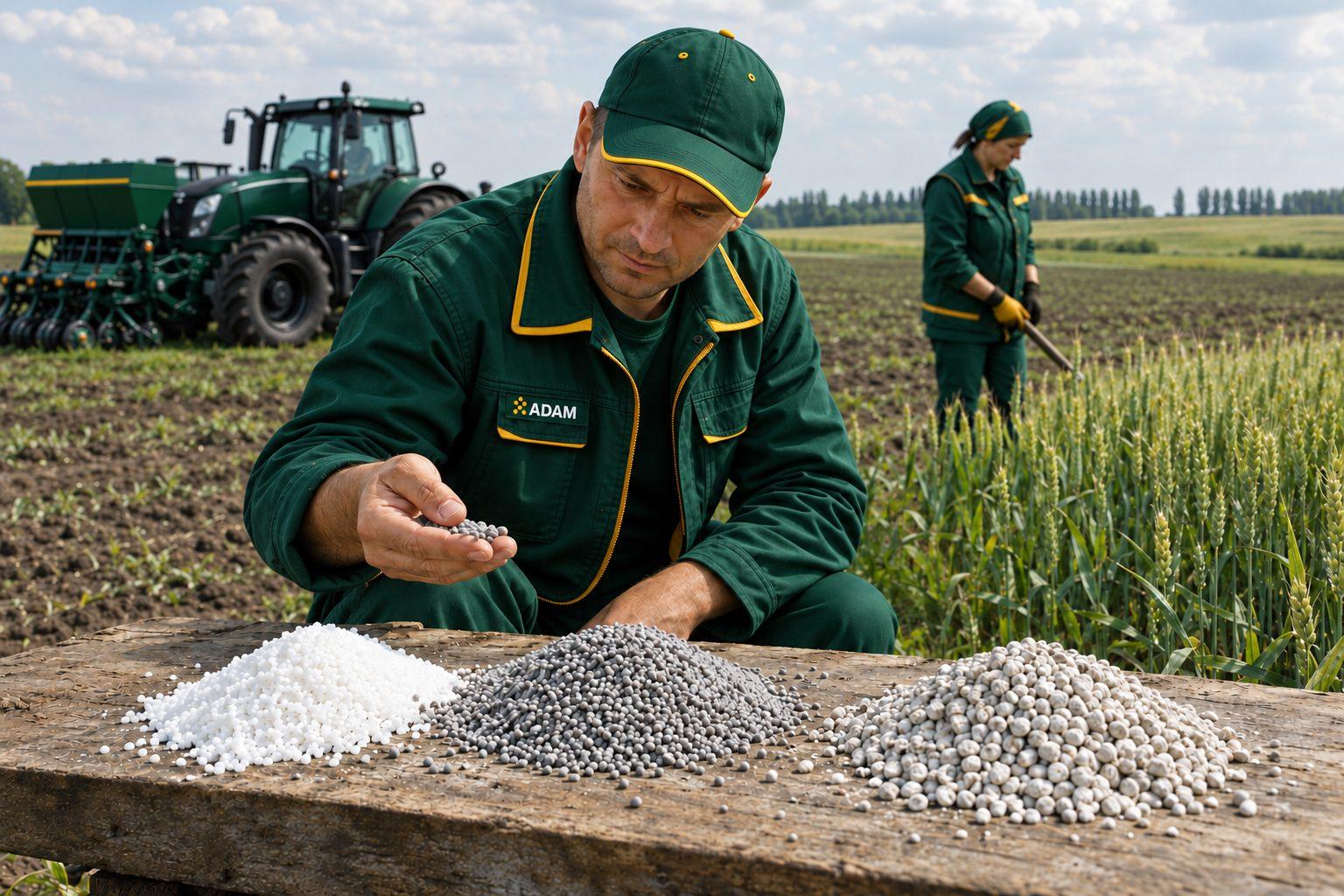
Compare 7 nitrogen fertilizers for Ukrainian winter wheat — urea, ammonium nitrate, UAN-32, CAN, sulfate, slow-release — with prices and rates.
For winter wheat in Ukraine, nitrogen is applied as UAN-32, urea, ammonium nitrate, CAN or ammonium sulfate. Which form is cheaper in the field depends on how it is applied: urea worked in the same day loses 3-6% of its nitrogen, on damp soil that dries in warm weather 20-40%, ammonium nitrate 2-4.3%.
How we tested
We compared 7 nitrogen fertilizers across five criteria: cost per 1 kg N, application uniformity (CV), nitrogen losses, herbicide tank-mix compatibility, and storage. Prices are State Statistics Service 2025 averages where it keeps a series. Agronomic parameters come from NUBiP and Institute of Grain Crops NAAS field trials in the Forest-Steppe and Steppe, 2025 season. Focus: winter wheat.
| Fertilizer | % N | Form | Price UAH/kg N | Strength |
|---|---|---|---|---|
| UAN-32 | 32% | Liquid | 49.3 (State Statistics, 2025) | Uniformity + tank-mixes |
| Urea | 46% | Granular | 44.7 (State Statistics, 2025) | Cheaper per kg N if worked in |
| Ammonium nitrate | 34.4% | Granular | 51.6 (State Statistics, 2025) | Acts fast in the cold |
| CAN N27 | 27% | Granular | not in State Statistics | Versatility + Ca |
| Ammonium sulfate | 21% | Granular | 59.5 (State Statistics, 2025) | Sulfur for Polissia |
| Urea-sulfate | 40% | Granular | not in State Statistics | N + S in one |
| Slow-release (polymer) | 45% | Granular | not in State Statistics | Single-pass season |
1. UAN-32 — best overall
Urea-ammonium-nitrate solution — 32% nitrogen in three forms (ammonium 8%, nitrate 8%, amide 16%) — is the all-purpose choice for farms above 500 ha with their own sprayer. The headline advantage is in-crop tank-mixing with herbicides (2,4-D, MCPA), which saves 1–2 field passes per season; UAN goes with glyphosate only in pre-sowing burndown, never over the standing crop. Application uniformity runs at a CV of 3–5% on a 24 m boom — 3× better than granular fertilizers from a spinner spreader. The downside: you need a boom sprayer with coarse-droplet AI 04–05 nozzles and an HDPE tank farm (30–50 m³ tanks, roughly 120,000–200,000 UAH installed). Optimal when annual volume exceeds 200 tonnes physical mass, so depreciation on the tanks and pumps spreads across enough hectares. Main Ukrainian suppliers: OSTCHEM, Group DF, Yara Ukraine; imports from Poland (Azoty Puławy) add 2–3% for logistics.
2. Urea
Urea (CO(NH₂)₂) contains 46% nitrogen in amide form. At the State Statistics Service's 2025 average prices it cost 20,557 UAH/t, 44.7 UAH per kg of nitrogen, 13.5% less than in ammonium nitrate (calculation). If it is not worked in the same day and about 13 mm of rain does not fall in one event within 24 hours, ammonia losses reach up to 16% in cool weather and 20-40% on damp soil that dries in warm weather. The urease inhibitor NBPT cuts them by about half on average. Plants do not take amide nitrogen directly from the soil: soil urease converts it to the ammonium form, on fertile soil with good moisture and temperature within 2-3 days (Hospodarenko, 2013). Spread onto snow, urea loses 20-25% of its nitrogen (Montana State University).
3. Ammonium nitrate
Ammonium nitrate contains 34.4% nitrogen (second grade 34%), half nitrate and half ammonium. At the State Statistics Service's 2025 average prices it cost 17,763 UAH/t, 51.6 UAH per kg of nitrogen (without VAT, delivered; calculation). Its nitrate half is fast-acting, so in a cold spring ammonium nitrate acts faster. Storage from 500 kg is governed by Ministry of Economy Order No. 775-21; none of the acts checked requires an SBU permit or video surveillance. The order requires keeping it apart from fuel and organic matter, at least 5 m from hay, straw, grain and feed or behind a barrier of inert material at least 1.5 m wide. The first top-dressing on frozen-thawed soil goes mainly to weak and thinned crops, 20-60 kg of nitrogen per hectare (58-174 kg of ammonium nitrate); for well-tillered crops it is moved to the end of tillering (NAAS institutes, 2021-2023).
4. CAN N27 — for cool springs
Calcium ammonium nitrate (CAN) N27 is a hybrid of ammonium nitrate with chalk or dolomitic limestone, 27% nitrogen; calcium and magnesium vary by grade (Rivneazot's register entry: CaO 4-22%, MgO 6%), so check the label. Its carbonates neutralize the physiological acidity of the ammonium nitrate, so it works better on acid soils, Polissia's among them (Hospodarenko's textbook), but it does not replace liming. CAN with 27% nitrogen is below the 28% threshold in the definition of ammonium nitrate in Ministry of Economy Order No. 775-21. Main Ukrainian supply comes from Poland (Anwil, Grupa Azoty Puławy) and Germany (Yara YaraBela Extran). 300 kg/ha of CAN brings only 54-102 kg of carbonates, while a full lime dose at a hydrolytic acidity of 3 is 4.5 t of CaCO₃, so it does not replace liming (our calculation).
5. Ammonium sulfate — for sulfur-deficient soils
Ammonium sulfate ((NH₄)₂SO₄) — 21% nitrogen plus 24% sulfur in sulfate form. At the State Statistics Service's 2025 average prices it cost 12,497 UAH/t, or 59.5 UAH per kg of nitrogen (excluding VAT, delivered; our calculation). More expensive than ammonium nitrate on a pure nitrogen basis, but the sulfur pays back on Polissia and Northern Forest-Steppe fields where sulfur is deficient. Sulfur concentration in Ukrainian soils has dropped 40% over the past decade as industrial emissions fell — sulfur is now a yield-limiting factor on many fields. Recommended rate: 80–120 kg/ha physical mass as part of spring top-dressing, paired with urea or ammonium nitrate. Also mildly acidifies carbonate soils by 0.1–0.2 pH units per season, useful on rapeseed and wheat ground. Suppliers: Yara (YaraBela Sulfan 24S), EuroChem (EuroSul), OSTCHEM (imported coke-oven by-product).
6. Urea-sulfate — N and S in one
Urea ammonium sulfate (UAS) is a stabilized urea + ammonium sulfate blend with 40% N and 6% S. State Statistics keeps no separate price series for urea ammonium sulfate, so no price is given here. Slightly more expensive than straight urea, but it saves one field pass compared to applying urea and ammonium sulfate separately — roughly 400 UAH/ha per spreader pass. Main market: large Forest-Steppe and Polissia farms (Vinnytsia, Khmelnytskyi, Zhytomyr) that need a balanced N+S profile without extra logistics. Stores like regular urea — no special warehouse or permits. Dense 2–4 mm granules give a spreader CV of 7–10% on a 28 m throw — better than straight ammonium nitrate. Suppliers: Yara International (YaraBela Sulphan), EuroChem (EuroSul), imports from Poland (Azoty Kędzierzyn).
7. Slow-release nitrogen — single-pass season
Polymer-coated urea (polymer slow-release) — 45% nitrogen with controlled release over 60–120 days, depending on coating thickness. State Statistics keeps no price series for coated urea, so no price is given here. The headline advantage: a single autumn or early-spring application replaces two separate passes, saving 760–1,040 UAH/ha on logistics and fuel. Pays back on farms with tight labor or limited machinery in peak season, and on irrigated Kherson and Mykolaiv ground where leaching losses of conventional N reach 20–30%. Nutrien ESN (Environmentally Smart Nitrogen) and ICL Nitrophoska lead the global market. Still a niche in Ukraine — under 1% of the nitrogen market — but growing 30% year-on-year since 2024. Suppliers: ICL Specialty Fertilizers, Yara, Nutrien via Agroscope Company.
How to choose
Which form of nitrogen to use is decided by the conditions of application, not by farm size. For the first top-dressing on frozen-thawed soil the Myronivka Wheat Institute names UAN, and calls applying ammonium nitrate traditional for many farms; the nitrate half of ammonium nitrate acts quickly (Hospodarenko, 2013), while urea hydrolyzes more slowly in cold soil. On acid soils CAN is more effective, especially with regular application (Hospodarenko, 2013). For seed crops the Myronivka Wheat Institute gives 25-30% of the full nitrogen rate in the first top-dressing and 45-60% in the second, at the start of stem elongation. Ammonia losses depend on the conditions too: urea worked in the same day loses 3-6% of its nitrogen, on damp soil that dries in warm weather 20-40%, ammonium nitrate 2-4.3%.
Sources
- Ministry of Agrarian Policy of Ukraine · minagro.gov.ua
- Institute of Grain Crops NAAS — nitrogen nutrition research · naas.gov.ua
- Yara International — agronomy resources · yara.com
Frequently asked questions
What did a kilogram of nitrogen cost in urea, ammonium nitrate and UAN in 2025?
At the State Statistics Service's 2025 average prices, a kilogram of nitrogen cost 44.7 UAH in urea, 51.6 UAH in ammonium nitrate and 49.3 UAH in UAN-32 (calculation). Urea not worked in the same day loses up to 16% of its nitrogen in cool weather and 20-40% on damp soil that dries in warm weather.
Does winter wheat need sulfur in Ukraine?
Yes — especially on Polissia and Northern Forest-Steppe soils. Sulfur concentration in Ukrainian soils has dropped 40% over the past decade as industrial emissions fell. Recommended rate: 15–25 kg/ha of actual sulfur as part of spring top-dressing via ammonium sulfate or urea-sulfate blends.
How is CAN different from ammonium nitrate?
CAN (calcium ammonium nitrate) is ammonium nitrate blended with chalk or limestone. It contains 27% nitrogen and calcium, whose share depends on the grade. It neutralizes acidic soils. CAN with 27% nitrogen is below the 28% threshold in the definition of ammonium nitrate in Ministry of Economy Order No. 775-21.
Is slow-release nitrogen worth using in Ukraine?
It is still a niche — under 1% of the market. It makes economic sense on farms with tight peak-season labor, or where one saved pass covers the higher price (380–520 UAH/ha per pass). For most Ukrainian farms, regular urea with NBPT is the better-value option.
How much nitrogen does winter wheat need in Ukraine?
The Ministry of Agrarian Policy recommends 120–180 kg/ha of actual nitrogen across the season. Use 140–160 kg/ha for Steppe and Forest-Steppe, and 160–180 kg/ha for Polissia where losses run higher on light soils. Subtract any nitrogen applied in autumn from these totals.