
Ammonium nitrate or urea: which is better, when, how to tell them apart
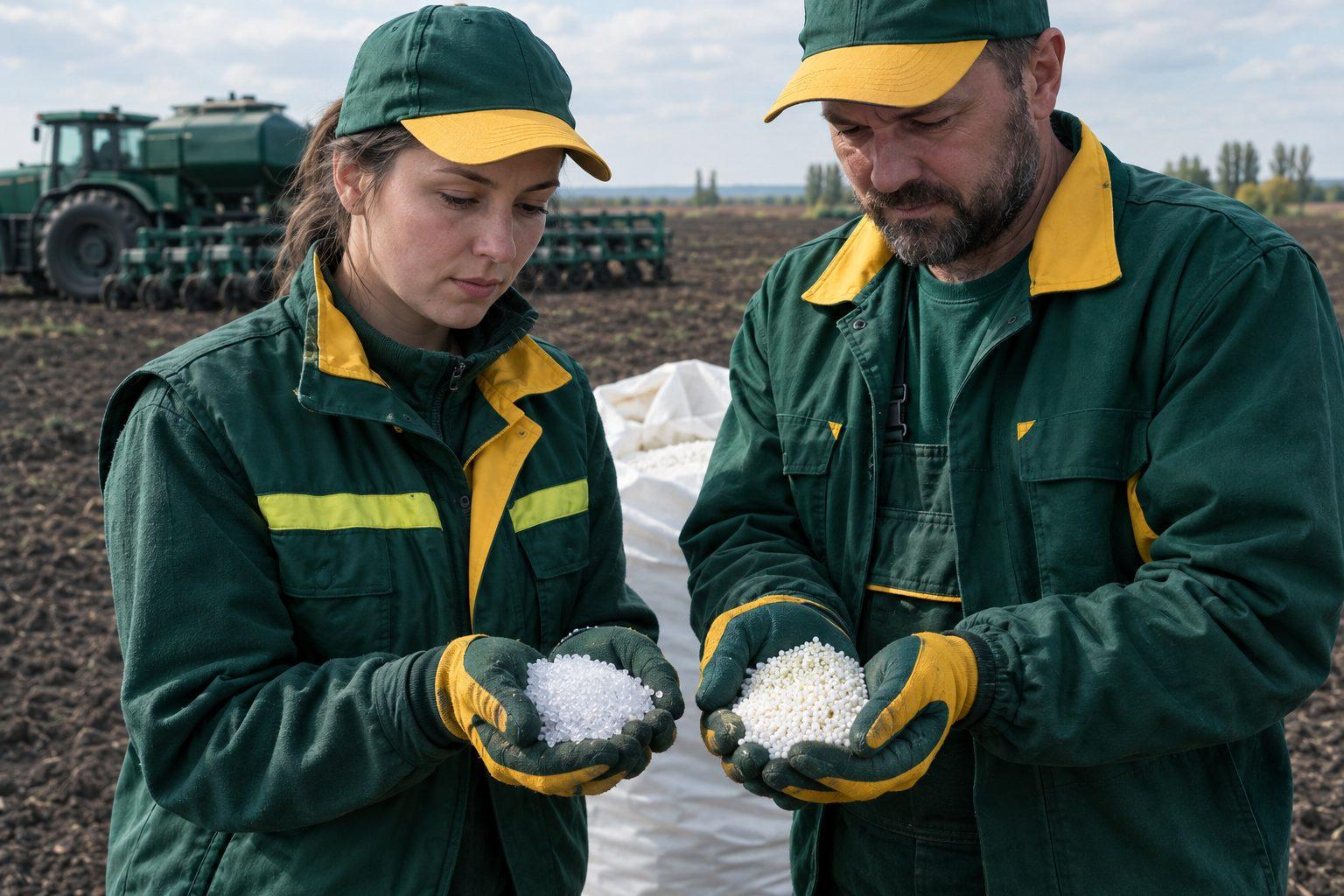
Ammonium nitrate or urea: cost per kg of nitrogen on 2025 State Statistics prices, losses by how it is spread, the line by oblast, telling and storing them.
Neither ammonium nitrate nor urea is always better. In 2025 nitrogen cost 44.7 UAH/kg in urea and 51.6 in ammonium nitrate (State Statistics, without VAT). Urea stays cheaper while it loses under 15-16%: worked in the same day it loses 3-6%, on damp soil drying in warmth 20-40%. Tell them apart by the bag.
Which is better, ammonium nitrate or urea? Neither in general: which one gives the cheaper kilogram of nitrogen reaching the crop is decided by how and when it is spread. Urea contains 46% nitrogen and ammonium nitrate 34.4%, so in 2025 the nitrogen in urea cost 13.5% less: 44.7 against 51.6 UAH per kilogram (the State Statistics Service's average price for agricultural enterprises, without VAT, delivered). Urea keeps this edge while it loses less than 15-16% of its nitrogen to the air: worked into the soil the same day it loses 3-6%, spread on damp soil that dries in warm weather 20-40%, while ammonium nitrate loses 2-4.3% and acts quickly in a cold spring. Tell them apart by the bag and the quality certificate; do not heat, burn or taste the granules.
What urea and ammonium nitrate are
Both are granular nitrogen fertilisers, but they are different substances (ureaa, in Ukrainian карбамід, ammonium nitratea, аміачна селітра). Urea, also called carbamide (сечовина), holds all its nitrogen in the amide form. In ammonium nitrate half the nitrogen is nitrate and half is ammonium.
| Feature | Urea | Ammonium nitrate |
|---|---|---|
| Formula | CO(NH₂)₂ | NH₄NO₃ |
| Nitrogen | 46%; grade B (Б) under DSTU 7312:2013 at least 46.2% on dry matter | 34.4%; second grade 34% |
| Nitrogen form | amide | nitrate and ammonium, in equal parts |
| Standard | DSTU 7312:2013 | DSTU 7370:2026, in force from 01.08.2026 |
| Granules | round, semi-transparent, 1-4 mm | white with a yellowish or reddish tint, 1-4 mm |
Urea is not a «селітра»: that word names the salts of nitric acid, that is, nitrates, while urea is an amide (Hospodarenko). There are also grades based on ammonium nitrate with 32-33.5% nitrogen, including ones with dolomite, so read the percentage on the bag. Calcium ammonium nitrate (CAN, ВАС) contains 20-28% nitrogen together with calcium carbonate, and calcium nitrate 15.5% nitrogen and calcium: these are other fertilisers with a different composition.
Which one acts faster
The nitrate half of ammonium nitrate acts quickly; the ammonium half moves less in the soil (Hospodarenko, 2013). Roots take up little urea as a molecule: first the soil enzyme urease converts it to ammonium. On fertile soil with good moisture and temperature this takes 2-3 days. Warmth, moisture and plenty of urease speed up the hydrolysis (Kansas State University, 2021), so in cold soil it goes more slowly; how many days exactly, none of the sources we opened says.
For the common phrase «urea acts more slowly but lasts longer» we found no source: after hydrolysis the nitrogen of urea behaves like ammonium nitrogen. Hospodarenko's textbook sums it up: nitrogen fertilisers applied in good time, before the crop starts taking up nitrogen, have the same value, and how well the ammonium and nitrate forms work depends on the conditions of application.
What a kilogram of nitrogen costs
The State Statistics Service (Держстат) publishes the average prices agricultural enterprises paid for fertilisers, without VAT and delivered. Per tonne, ammonium nitrate is cheaper, in 2025 in every oblast with data, but a tonne of urea contains 460 kg of nitrogen and a tonne of ammonium nitrate 344 kg, so per kilogram of nitrogen urea is cheaper.
| Year | Urea, UAH/t | Urea, UAH per kg N | Ammonium nitrate, UAH/t | Ammonium nitrate, UAH per kg N |
|---|---|---|---|---|
| 2023 | 22 960 | 49.9 | 20 822 | 60.5 |
| 2024 | 18 131 | 39.4 | 15 517 | 45.1 |
| 2025 | 20 557 | 44.7 | 17 763 | 51.6 |
The nitrogen in urea was cheaper by 17.5% in 2023, by 12.6% in 2024 and by 13.5% in 2025. These are last year's average prices, not today's. Freight of 1 000 UAH per tonne adds 2.17 UAH to a kilogram of nitrogen in urea and 2.91 UAH in ammonium nitrate (calculation). The ADAM catalogue (ureaa, ammonium nitratea) has no active offers as of 10.11.2026.
Where the nitrogen goes: losses by how it is spread
Urea loses nitrogen mainly as ammonia, ammonium nitrate with water. The EU emission inventory gives surface urea 16% of its nitrogen on average and ammonium nitrate 2%, or 4.3% on soils with pH above 7 (EMEP/EEA, 2023). Measured losses from ammonium nitrate did not exceed 4%; from urea they ran from 6 to 47%.
| How it is spread | Urea loses | Ammonium nitrate loses |
|---|---|---|
| Worked into the soil the same day, or about 13 mm of rain fell in one go within 24 hours | 3-6% | 2-3% |
| On the surface, cool, soil pH 7 or below | 10-16% | 2-3% |
| On the surface of damp soil that dries in warmth, or on soil with pH above 7, or on residue | 20-40% | 2-4.3% |
| Onto snow | 20-25% | no measured band |
| Frozen soil, 25 mm of water right away (one study) | about 25% with runoff | about 25% with runoff |
| Light sandy soil | more ammonia | nitrate leaches |
Light rain can increase urea's losses: the surface gets wet and dries again (Montana). The urease inhibitor NBPTa cuts urea's losses by about half on average, but on soil with pH 4.5 only by 18% (Cantarella et al., 2018). We found no field measurements of ammonia loss from urea on Ukrainian chernozems.
Which is better: when urea stops being cheaper
There is no winner: urea is cheaper per kilogram of nitrogen until its losses eat up the price gap. Across Ukraine in 2025 that line was 15-16% loss (calculated from State Statistics prices and the loss bands above).
Across Ukraine
Urea worked in the same day is cheaper. On the surface in cool weather it loses 10-16%, so it sits on the line. On damp soil that dries in warmth, ammonium nitrate gives the cheaper nitrogen. The line moves with prices: in 2023 it was 19-20%, in 2024 14-15%.
By oblast, 2025
| Oblast (UAH per kg N: urea / ammonium nitrate) | Urea is cheaper while it loses less than | Surface, cool | Damp surface dries in warmth |
|---|---|---|---|
| Kyiv City (43.0 / 53.7) | 22% | urea | on the line |
| Odesa (45.2 / 56.3) | 21-22% | urea | on the line |
| Lviv (43.5 / 52.5) | 19-20% | urea | on the line |
| Rivne (44.5 / 53.7) | 19-20% | urea | on the line |
| Dnipropetrovsk (45.2 / 54.3) | 18-19% | urea | on the line |
| Vinnytsia (44.0 / 52.9) | 18-19% | urea | on the line |
| Cherkasy (43.9 / 52.4) | 18-19% | urea | ammonium nitrate |
| Volyn (44.0 / 52.1) | 17-18% | urea | ammonium nitrate |
| Zhytomyr (45.5 / 53.6) | 17-18% | urea | ammonium nitrate |
| Sumy (43.5 / 50.5) | 16-17% | on the line | ammonium nitrate |
| Kirovohrad (42.7 / 49.4) | 15-16% | on the line | ammonium nitrate |
| Kyiv Oblast (45.1 / 52.3) | 15-16% | on the line | ammonium nitrate |
| Ukraine, average (44.7 / 51.6) | 15-16% | on the line | ammonium nitrate |
| Ternopil (45.4 / 52.3) | 15-16% | on the line | ammonium nitrate |
| Donetsk (44.6 / 51.3) | 15-16% | on the line | ammonium nitrate |
| Chernihiv (44.4 / 51.0) | 15% | on the line | ammonium nitrate |
| Zaporizhzhia (44.2 / 50.7) | 14-15% | on the line | ammonium nitrate |
| Kharkiv (45.6 / 52.1) | 14-15% | on the line | ammonium nitrate |
| Ivano-Frankivsk (43.4 / 48.4) | 12-13% | on the line | ammonium nitrate |
| Zakarpattia (46.4 / 51.7) | 12-13% | on the line | ammonium nitrate |
| Kherson (43.6 / 48.1) | 11-12% | on the line | ammonium nitrate |
| Mykolaiv (47.3 / 51.5) | 10-11% | on the line | ammonium nitrate |
| Poltava (47.7 / 50.6) | 8-9% | ammonium nitrate | ammonium nitrate |
| Chernivtsi (45.2 / 47.1) | 6-7% | ammonium nitrate | ammonium nitrate |
| Khmelnytskyi (46.0 / 47.1) | 4-5% | ammonium nitrate | ammonium nitrate |
«On the line» means that urea's loss range from the table above crosses the line, and the answer depends on how much it loses on your field. Urea worked in the same day is cheaper everywhere except Chernivtsi and Khmelnytskyi oblasts, where it is on the line. Onto snow urea loses 20-25%, and there is no measured band for ammonium nitrate, so we draw no line.
For your ammonium nitrate price
The table shows the urea price at which a kilogram of nitrogen reaching the crop costs as much as in ammonium nitrate at your price. Both prices must be on the same terms: with or without VAT, delivered or not. For your own oblast or price, you can ask Adama in the chat.
| Ammonium nitrate, UAH/t | Worked in the same day | Surface, cool | Damp surface dries in warmth |
|---|---|---|---|
| 18 000 | 23 100-24 100 | 20 600-22 300 | 14 700-20 100 |
| 22 000 | 28 200-29 400 | 25 200-27 300 | 18 000-24 600 |
| 26 000 | 33 300-34 800 | 29 800-32 300 | 21 300-29 100 |
| 30 000 | 38 500-40 100 | 34 400-37 200 | 24 600-33 500 |
Soil, weather and season
- <strong>Cold spring, frozen-thawed soil.</strong> The nitrate in ammonium nitrate acts quickly. Urea loses less in the cold (Kansas), but onto snow it lost 20-25%, and it is not spread on damp soil even in the cold (Montana).
- <strong>Frozen soil and rain.</strong> In one Kansas study, 25 mm of water on frozen soil right after spreading washed off about 25% of each fertiliser.
- <strong>Calcareous soil, pH above 7.</strong> Urea's losses rise, ammonium nitrate's only to 4.3% (EMEP/EEA, 2023).
- <strong>Light sandy soil.</strong> Both lose: urea more ammonia (Manitoba), ammonium nitrate its nitrate with rain (Hospodarenko).
- <strong>Waterlogged soil.</strong> Nitrate is lost to denitrification (Arkansas).
- <strong>Acid soil.</strong> The acidity from a kilogram of nitrogen in either is offset by about 2 kg of lime: 1.7 kg for urea and 2.2 kg for ammonium nitrate by Hospodarenko (calculation), 1.8 kg each by Cornell; ammonium sulphate needs three times that.
- <strong>Autumn.</strong> Nitrate from fertiliser applied early washes out with autumn and winter rain (Hospodarenko). In Montana, winter wheat grain held 26% of urea nitrogen from a late-autumn application and 37% from a spring one.
Winter wheat and maize
The NAAS Myronivka Wheat Institute (2023) sets out three top-dressings for winter wheat grown for seed and names the form of nitrogen for each.
- <strong>The first,</strong> 25-30% of the nitrogen rate, on frozen-thawed soil before growth resumes. The institute names UAN, and calls applying ammonium nitrate «traditional» for many farms; urea is then applied as a solution.
- <strong>The second,</strong> 45-60% of the rate, at the start of stem elongation: nitrogen goes on «mainly in the form of ammonium nitrate».
- <strong>The third,</strong> from heading to grain fill, foliar, with amide nitrogen, that is urea or its mixtures, for seed quality.
Maize: the NAAS Institute of Grain Crops (Steppe, 2021) considers a root-zone top-dressing of N15-20 early in growth under unstable moisture not effective enough and advises replacing it with a foliar urea feed at the 6-7 leaf stage. Rates and solution strengths are on the pages about ureaa and ammonium nitratea, and the nitrogen rate calculatora works out the nitrogen needed per hectare.
How to tell urea from ammonium nitrate
A document tells them apart reliably. On the bag, read the name, the nitrogen content and the standard: DSTU 7312 for urea, DSTU 7370 for ammonium nitrate. For a batch, ask the seller for the manufacturer's quality certificate.
Appearance gives only a hint. Urea granules are round and semi-transparent, ammonium nitrate granules white with a yellowish or reddish tint, both 1-4 mm (Hospodarenko); fertiliser-grade ammonium nitrate ranges from colourless to grey or brown (PubChem). Ammonium nitrate cakes more easilya: bulk urea keeps without caking for about six months, and then, unlike ammonium nitrate, crusts only on top. A water test will not help: both dissolve readily.
Why the State Register will not help
As of November 2026, neither urea nor ammonium nitrate needs state registration. The Law «On pesticides and agrochemicals», in the edition of 15.11.2024 in force on 19.10.2026, has an annex listing agrochemicals that may be imported, produced, sold, used and advertised without state registration. It includes urea, ammonium nitrate, calcium ammonium nitrate and UAN. The annex appeared in 2015 (Law No. 867-VIII).
The public file of the State Register of Pesticides and Agrochemicals of 19.10.2026 holds no valid entry for straight urea or ammonium nitrate: the last ones expired on 31.12.2025. Check other things instead: the name, nitrogen content and standard on the bag, and the batch's quality certificate. Under the law, businesses that store, apply or sell agrochemicals insure their liability (Art. 11), and enterprises keep records of them (Art. 14); this applies to both fertilisers.
Storage, and why they are not mixed
As of November 2026 we found no separate order on storing urea; its standard sets the requirements for the store. For ammonium nitrate there is Ministry of Economy Order No. 775-21: it applies to every business storing 500 kg of ammonium nitrate or more, that is, from 20 bags of 25 kg (calculation).
- On a farm, ammonium nitrate is kept apart from hay, straw, grain, feed and other organic matter: at least 5 m away or behind an inert-material barrier at least 1.5 m wide.
- In bulk it is stored for no more than six months, in bags in the open for no more than a month, protected from rain and sun.
- Fuel, solvents, sulphur, lime, cement and other alkalis are not kept in the same store: with alkalis, ammonium nitrate releases ammonia.
- Urea and ammonium nitrate may be stored in one building if a vehicle aisle is left between the stacks.
They must not be mixed, for example in one spreader hopper (Hospodarenko, Table 3.8): the mixture becomes too hygroscopic (NUBiP Boiarka Professional College guide, 2026).
In the vegetable garden and orchard
In the garden the logic is the same as in the field. In a cold spring ammonium nitrate acts faster, because its nitrate half is fast-acting. Urea scattered on the surface must be worked in or watered in: about 13 mm of water in one go within 24 hours, from rain or watering, mostly removes the ammonia loss (Kansas State University), while light rain can increase it (Montana). They acidify the soil about equally, about 2 kg of lime per kilogram of nitrogen (calculated from Hospodarenko). We found no trials comparing the two fertilisers on garlic, raspberries or fruit trees. There are no garden rates here: they are on the pages about ureaa and ammonium nitratea. To convert a rate per hectare to a square metre: 1 kg/ha equals 0.1 g/m², so 100 kg/ha is 10 g/m² (calculation).
Common mistakes
- <strong>Urea on damp soil before warm, dry weather.</strong> The worst case: 20-40% of the nitrogen goes into the air.
- <strong>Counting light rain as working in.</strong> It takes about 13 mm at once within 24 hours.
- <strong>Ammonium nitrate on frozen soil before rain.</strong> In one study it lost as much to runoff as urea.
- <strong>Comparing per tonne.</strong> Compare the price per kilogram of nitrogen.
- <strong>Urea and ammonium nitrate in one hopper.</strong> The mixture quickly takes up moisture.
- <strong>Fire, heat or taste tests.</strong> Dangerous for ammonium nitrate, and the smoke of both is toxic.
- <strong>Ammonium nitrate next to hay, grain, fuel or lime.</strong> From 500 kg, Order No. 775-21 forbids it.
How we checked: on 11.11.2026 a separate check, not by the text's author, reopened every source listed below: the law and Order No. 775-21 in archived copies, the register file, the DSTU standards, the textbook, the institutes' recommendations, the loss studies and PubChem. State Statistics prices come from ADAM's copy of 07.11.2026; the lines and price tables were recalculated. The text was written and checked with the help of AI.
Sources
- Law of Ukraine «On pesticides and agrochemicals» No. 86/95-VR and its annex of agrochemicals allowed without state registration (annex added by Law 867-VIII of 08.12.2015), edition of 15.11.2024, current on 19.10.2026 · zakon.rada.gov.ua
- Ministry of Economy Order No. 775-21 of 15.04.2021: minimum safety and health requirements for storing and packing ammonium nitrate (in force 18.05.2021) · zakon.rada.gov.ua
- State Register of Pesticides and Agrochemicals, Ministry of Economy public file of 19.10.2026 (published 20.10.2026), read 10.11.2026 · me.gov.ua
- State Statistics Service: average purchase prices of mineral fertilisers paid by agricultural enterprises, UAH/t without VAT, delivered, 2023-2025 (published 08.06.2026) · stat.gov.ua
- DSTU 7312:2013 Urea. Specifications (in force 01.01.2014; text on a reference mirror) · dnaop.com
- Budstandart: DSTU 7370:2026 Ammonium nitrate. Specifications in force from 01.08.2026, DSTU 7370:2013 cancelled from 01.02.2027 (10.04.2026) · online.budstandart.com
- Hospodarenko H. M.: Agrochemistry, university textbook, Kyiv: Ahrarna osvita, 2013 (copy on a college server) · learn.zhatk.zt.ua
- NAAS Myronivka Wheat Institute: technology of growing winter wheat seed, methodical recommendations (2023) · mip.com.ua
- NAAS Institute of Grain Crops: growing crops under climate change in 2021, recommendations for the Steppe (2021) · market.institut-zerna.com
- EMEP/EEA air pollutant emission inventory guidebook 2023, 3.D Crop production and agricultural soils · eea.europa.eu
- Umweltbundesamt: Germany's Informative Inventory Report 2025, 3.D agricultural soils · iir.umweltbundesamt.de
- Ruiz Diaz, Kansas State University: Management practices affecting nitrogen loss from urea, MF894 (June 2021) · bookstore.ksre.ksu.edu
- Montana State University: urea volatilization research, What have we learned? (undated, read 10.11.2026) · landresources.montana.edu
- Manitoba Agriculture: Volatilization losses from surface applied nitrogen (undated, read 10.11.2026) · gov.mb.ca
- Cantarella, Otto, Soares, Silva: Agronomic efficiency of NBPT as a urease inhibitor, a review, Journal of Advanced Research 13:19-27 (2018) · pmc.ncbi.nlm.nih.gov
- Roberts and Norman, University of Arkansas: Nitrogen fertilizer additives, FSA2169 (undated, read 10.11.2026) · uaex.uada.edu
- Cornell University NRCCA study resources: long-term change in soil pH from applying nitrogen (undated, read 10.11.2026) · nrcca.cals.cornell.edu
- PubChem: ammonium nitrate, CID 22985, safety and properties (read 11.11.2026) · pubchem.ncbi.nlm.nih.gov
- PubChem: urea, CID 1176, properties (read 11.11.2026) · pubchem.ncbi.nlm.nih.gov
- Yevpak, Manishevska, Pavliuk, Semenko (Boiarka Professional College of NUBiP): studying mineral fertilisers by appearance and qualitative reactions, methodological guide (approved 21.04.2026) · dglib.nubip.edu.ua
Frequently asked questions
Which is better: ammonium nitrate or urea?
It depends on how and when you spread it. In 2025 a kilogram of nitrogen cost 44.7 UAH in urea and 51.6 UAH in ammonium nitrate (State Statistics, without VAT, delivered). Urea is cheaper while it loses less than 15-16% of its nitrogen: worked in the same day it loses 3-6%, on damp soil that dries in warmth 20-40%. Ammonium nitrate loses 2-4.3% and acts quickly in a cold spring.
Is urea a nitrate (селітра)?
No. «Селітри» are the salts of nitric acid, that is, nitrates: ammonium, calcium, potassium and sodium nitrate. Urea, also called carbamide, is an amide. Its nitrogen becomes available to roots once the soil enzyme urease converts it to ammonium: on fertile soil with good moisture and temperature, in 2-3 days.
Which fertiliser contains the most nitrogen?
Among solid nitrogen fertilisers, urea has the most: 46%, and grade B (Б) under DSTU 7312:2013 at least 46.2% on dry matter. Ammonium nitrate has 34.4%, calcium ammonium nitrate 20-28%, ammonium sulphate 21%. So a tonne of urea carries more nitrogen, even though it costs more per tonne.
What does urea look like?
Urea is sold as white or slightly coloured granules; under DSTU 7312:2013, granules of 1-4 mm make up at least 94% of the mass. The granules are round and semi-transparent. Ammonium nitrate looks similar, but its granules are white with a yellowish or reddish tint. You cannot tell them apart by look for certain: read the bag and the quality certificate.
Which is better for maize: ammonium nitrate or urea?
The sources we read contain no direct comparison of the two fertilisers on maize. For the Steppe, the NAAS Institute of Grain Crops (2021) considers an early root-zone dose of N15-20 under unstable moisture not effective enough and advises replacing it with a foliar urea feed at the 6-7 leaf stage. For soil application the same logic holds: urea worked in is cheaper almost everywhere, while on the surface in warm weather it loses more.
Which is better for garlic: ammonium nitrate or urea?
We found no trials comparing the two fertilisers on garlic. The logic is the same as in the field: in a cold spring ammonium nitrate acts faster, while urea on the surface must be worked in or watered in, with about 13 mm of water in one go within 24 hours. Garden rates are on the pages about urea and ammonium nitrate; 1 kg/ha equals 0.1 g/m².