
Soil acidity: how to test soil pH and what to lime with
How to determine soil acidity: which pH a lab measures, when a field needs lime, how much lime or dolomite flour to apply per hectare and per sotka.
Only a lab's salt pH (pH KCl) and hydrolytic acidity (Нг) give a lime dose. At pH KCl 5.5 or below a field is limed (at 5.1-5.5 sandy soils last); at 5.6-6.0 only for demanding crops; above 6.5 no liming. Full dose: 1.5 t CaCO₃/ha per unit of Нг, divided by the material's neutralising value.
Soil acidity decides whether a field needs lime, and only a lab pH measured in potassium chloride solution (salt pH, pH KCl) can set the dose: Ukraine's liming tables are read on it. At salt pH 5.5 or below a field needs liming, though at 5.1-5.5 sandy soils are limed last; at 5.6-6.0 only for crops that demand lime, such as lucerne or beet; above 6.5 no liming is needed. The full dose is 1.5 t of CaCO₃ per hectare for each unit of hydrolytic acidity on the lab report, divided by the neutralising value of the material you buy: 4.8 t of CaCO₃ is about 5.2 t of dolomite flour (calculation). A test strip shows water pH, fizzing under acid shows carbonates, and probes measured poorly in a university test: none of them gives a dose. In the last state agrochemical survey (2016-2020), 24% of the farmland surveyed was acid, and 48% in Polissia.
What soil acidity is: water pH, salt pH and hydrolytic acidity
Soil pHa shows the reaction of the soil solution: the lower the number, the more acid the soil. Active acidity is measured in a water extract as water pH (pH H₂O). Potential acidity is found with salt solutions: exchangeable acidity (salt pH) in a potassium chloride extract, and hydrolytic acidity (Нг), in mg-eq/100 g of soil, which sets the lime dose (monograph of the Institute of Agriculture of NAAS, Ukraine's National Academy of Agrarian Sciences, 2019).
Salt pH is lower because potassium chloride pushes exchangeable aluminium into solution; FAO says the gap is up to one unit. G. M. Hospodarenko's textbook sets the acid class limits 0.5 lower for salt pH than for water pH. In 46 pairs of Ukrainian and Kazakh soil layers with both measured, the median water pH was 0.30 higher (ADAM soil data check, 06.11.2026). So for one field, one pH is not converted into the other.
State classes by pH: very strongly acid below 4.1, strongly acid 4.1-4.5, moderately acid 4.6-5.0, slightly acid 5.1-5.5, near neutral 5.6-6.0, neutral 6.1-7.0 (Agrochemical Passport Methodology, 2019).
How acid Ukraine's fields are: the state survey data
The Institute of Soil Protection of Ukraine carried out round XI of the agrochemical survey (2016-2020) on 8.58 million ha of farmland; in 1966-1970 the survey covered 30.9 million ha of arable land. Acid soils made up 24.4% of the area surveyed, 2.1 million ha, with a mean pH of 6.2: these are the lands surveyed, not the whole country.
| Zone or oblast | Acid soils, % | Mean pH |
|---|---|---|
| Polissia | 48.4 | 5.69 |
| Forest-Steppe | 30.0 | 5.95 |
| Steppe | 2.1 | 6.83 |
| Zakarpattia | 66.0 | 5.24 |
| Chernihiv | 61.9 | 5.47 |
| Vinnytsia | 57.8 | 5.5 |
| Zhytomyr | 57.0 | 5.5 |
Acidification continues in 12 oblasts; the report shows the largest five-year increase in the area of acid soils, 11.4%, in Zhytomyr oblast. 1,564 thousand ha were limed in 1990 and 118.8 thousand ha in 2020. By the report, that is 1.9% of the area of acid soils; it does not say which area it was calculated from.
How a lab measures pH and which pH is in your passport
Soil pH is measured under DSTU ISO 10390:2022: with an electrode in a 1:5 soil suspension in water, 1 mol/L potassium chloride or 0.01 mol/L calcium chloride. The standard came into force on 16.05.2022 by Order No. 70 of 09.05.2022 of the national standards body DP UkrNDNC and replaced DSTU ISO 10390:2007, cancelled from 01.01.2023.
Which pH your passport shows depends on the zone. The passport methodology (2019, p. 47) requires hydrolytic acidity and salt pH for Polissia and the Forest-Steppe, while in the Steppe the reaction is found from the pH of a water suspension. So a Steppe passport prints water pH, but the liming tables are built on salt pH.
Arable land gets a passport every 5 years, hayfields, pastures and perennial plantings every 5-10 years (Ministry of Agrarian Policy Order No. 536 of 11.10.2011, item 1.5). Cabinet of Ministers Resolution No. 848 of 23.07.2024 sets the same cycle but is not yet in force: it takes effect together with Law No. 2973-IX, still not in force as of October 2026. Hydrolytic acidity is determined under DSTU 7537:2014.
Which test to order and what it costs
The state analysis and the agrochemical passport are done by the Institute of Soil Protection of Ukraine through its regional centres. As of November 2026 it offers three sets of indicators:
| Set | Price per sample | What it includes |
|---|---|---|
| Minimum | 599.64 UAH | 5 indicators: salt pH, humus, easily hydrolysable nitrogen, mobile phosphorus and potassium |
| Basic | 996.36 UAH | 9: the minimum set, hydrolytic acidity, exchangeable calcium and magnesium, mobile sulphur |
| Extended | 5,611.92 UAH | 23: the basic set, micronutrients, heavy metals, residues of HCH, DDT and 2,4-D, caesium-137 |
These are minimum prices without transport, and they may vary with the place of the survey; the analysis takes 3 weeks. For a lime dose, order the basic set: the minimum one has no hydrolytic acidity. On sandy and sandy loam soils, ask for the dose to be calculated from pH buffering capacity: the Sokolovsky Institute of Soil Science and Agrochemistry considers this calculation much more accurate. Where else to test soil: the answer in our FAQa. More on soil testing: the blog's Soila section.
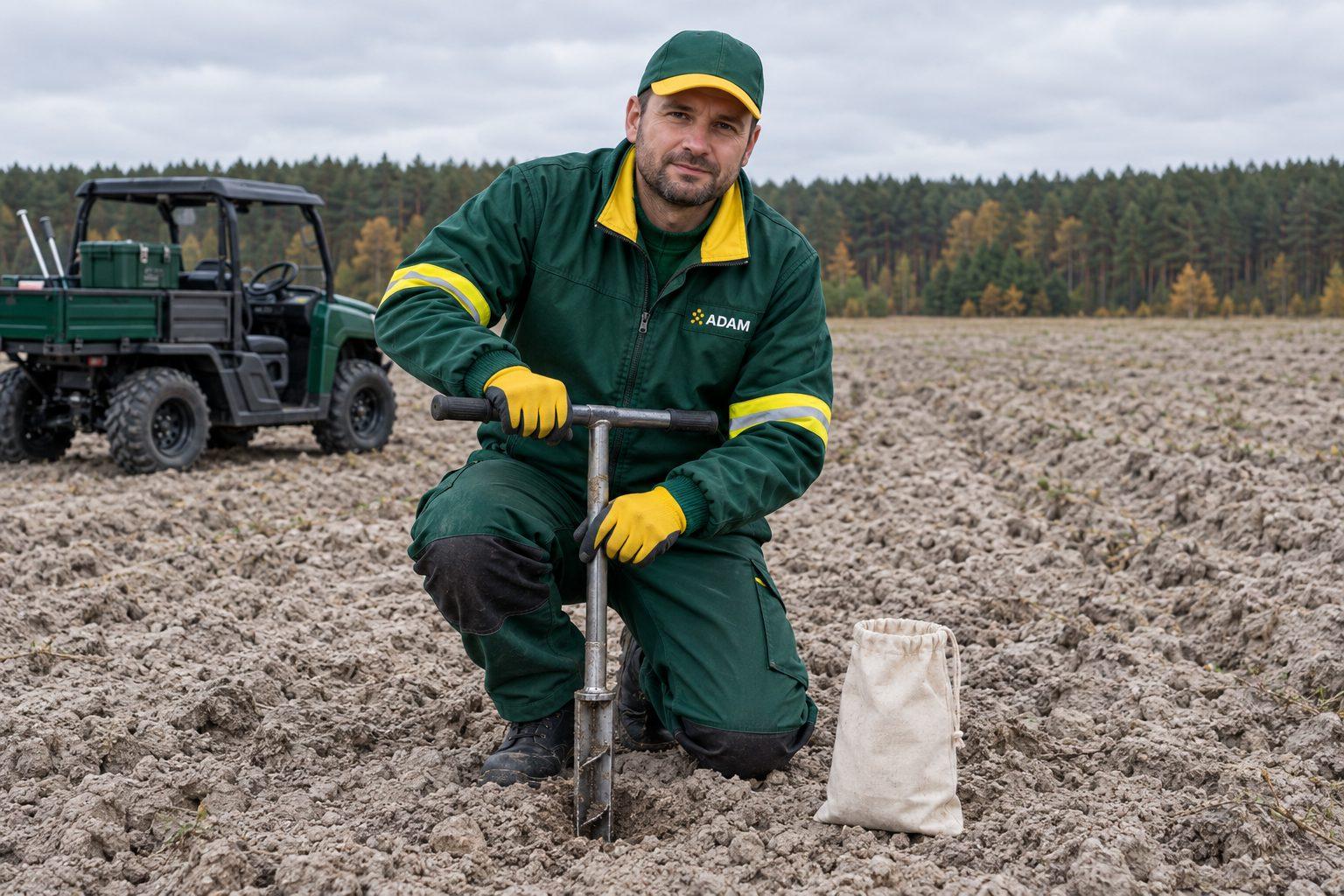
How to take a soil sample
The state Agrochemical Passport Methodology (2019) takes samples as follows:
- <strong>Depth.</strong> The auger goes in vertically to the depth of the plough layer, but no less than 20 cm.
- <strong>Composite sample.</strong> 20-25 spot samples, 400-500 g in all; the spot samples are taken along a route across the plot.
- <strong>Area per sample.</strong> On rain-fed arable land at most 8 ha in Polissia, 15 in the Forest-Steppe, 20 in the Steppe, 5 in Zakarpattia (for fields over 30 ha in Polissia and Zakarpattia, over 50 ha in the Forest-Steppe and Steppe); less on drained and irrigated land.
- <strong>Where not to sample.</strong> Closer than 30 m to roads, buildings, shelterbelts and fertiliser stores, and in furrows and gullies.
- <strong>Separately.</strong> Each crop and each noticeably different soil.
- <strong>When.</strong> From the time the soil warms to +5 °C until it freezes; if more than 90 kg/ha of active ingredient of any fertiliser was applied, no earlier than two months after application.
Strips, pH meter, vinegar and soda: what each one shows
An indicator strip in a 1:5 extract of soil in distilled water shows pH to within a unit or even a tenth (a practical of Tavria State Agrotechnological University), but it is water pH.
Probes pushed into the soil were judged this way by the University of Missouri after comparing kits (2001): "Soil pH probes gave poor measurements of soil acidity and should not be used by Extension agents". Three cheap kits in a South Dakota State University test (2025) mostly came within one unit of the lab pH, but one showed 8 on one sample against the lab's 6.2.
Fizzing of soil under acid shows carbonates: university practicals drip 10% hydrochloric acid on it, and the stronger the fizz, the more carbonates. These practicals describe no vinegar test, and none of them derives pH from fizzing. No Ukrainian research institution describes a soda test. ADAM's field map shows modelled water pH only as a class, without a dose.
Signs in the field: crops and weeds
G. M. Hospodarenko's agrochemistry textbook (2013) names the signs of acid soil: poor growth and thinning of clover, lucerne, beet and winter wheat after winter, and plenty of acid-tolerant plants: sorrel, sedge, hemp-nettle, creeping buttercup, tufted hair-grass, heather, field horsetail. If oak, beech, black locust and dog rose grow well in field shelterbelts, the soil, by the textbook, needs no liming. Plenty of goosefoot and nettle means the soil is neutral and rich in nutrients.
The same textbook warns that acidity and the need for liming are judged more precisely from agrochemical indicators, exchangeable and hydrolytic acidity and base saturation, taking the soil and crops into account. It does not name the dandelion among the signs, nor soil hardness: for that, see the glossary entry on soil compactiona. The signs show where to take a sample; the dose comes from the analysis.
When a field needs liming
The monograph of the NAAS Institute of Agriculture (2019) sets the need for liming by salt pH; Hospodarenko's textbook gives the same limits.
| Salt pH | Need for liming |
|---|---|
| 4.5 and below | first priority in all rotations |
| 4.6-5.0 | first priority in vegetable and fodder rotations on sandy loam and loam soils; medium in field rotations on sandy soils |
| 5.1-5.5 | large on sandy loam and loam soils, especially in fodder, vegetable and grass rotations; sandy soils last |
| 5.6-6.0 | selective, above all in rotations with crops that demand lime |
| above 6.5 | not needed |
By hydrolytic acidity: from 4 mg-eq per 100 g, first-priority liming in all zones; 3-4, first priority in Polissia and the Forest-Steppe; 2-3, a medium need; 1.5 and below, no liming needed. Base saturation refines this: below 50% the need is strong, above 80% there is none.
Other sources draw the line elsewhere: the textbook "Crop Production" (2001) limes field crops below 6.0, and the methodical recommendations of the Central Ukrainian National Technical University (2020) give 5.5 for Polissia, 5.9 for the grey forest soils of the Forest-Steppe and 6.5 for Steppe chernozems, without saying whether this is salt or water pH.
Which crops lose most on acid soil
The state survey report says crops sensitive to acidity lose 20-60% of their yield. Hospodarenko's textbook divides crops into five groups. Lucerne, melilot, beet, cabbage, garlic, apple, cherry, plum and currant respond to lime even on slightly acid soils. Wheat, maize, barley, soybean, pea, sunflower and clover need a slightly acid or near-neutral reaction. Rye, oats, buckwheat and tomato are only slightly sensitive; potato and flax tolerate excess calcium poorly; lupin grows best at pH 4.5-5.0.
| Crop | Optimal pH |
|---|---|
| Sugar beet | 7.0-7.5 |
| Lucerne | 7.0-8.0 |
| Winter wheat | 6.3-7.5 |
| Soybean | 6.5-7.1 |
| Maize | 6.0-7.0 |
| Sunflower | 6.0-6.8 |
| Potato | 5.0-5.5 |
The yield gain from liming, by the textbook: winter wheat in Polissia 0.20-0.55 t/ha, grain maize in the same zone 0.30-0.98 t/ha, sugar beet in the Forest-Steppe 1.7-5.0 t/ha.
How much lime: the dose from hydrolytic acidity
The most common calculation in Ukraine gives the full CaCO₃ dose in tonnes per hectare: hydrolytic acidity in mg-eq per 100 g multiplied by 1.5 (Hospodarenko, 2013, p. 57). The formula assumes a plough layer of medium loam weighing 3,000 t per hectare. The NAAS monograph (2019, app. 4) gives the share of the full dose for Polissia and the Forest-Steppe: sod-podzolica sandy and loamy sand soils 0.75, surface-gleyed 0.5, sandy loam, loam, grey podzolized soils and podzolized chernozems 1.0. With higher mineral fertiliser rates the dose can be raised to the full one.
The Sokolovsky Institute of Soil Science and Agrochemistry warns that a dose from Нг often over-limes soils with low pH buffering capacity and under-limes soils with high capacity (Tsapko et al., 2018). In its long-term trials, 4-6 t/ha of CaCO₃ on acid sod-podzolic soils raised salt pH by 1.0-1.5 units and grain yields by 0.6-1.8 t/ha (as cited in the state survey report).
Without hydrolytic acidity: the dose from pH and soil texture
If the lab report has only salt pH, an approximate dose comes from table 2.5 of Hospodarenko's textbook for soils with less than 3% humus:
| Salt pH | Sandy loam and light loam, t/ha CaCO₃ | Medium and heavy loam, t/ha CaCO₃ |
|---|---|---|
| below 4.5 | 4.0 | 6.0 |
| 4.6 | 3.5 | 5.5 |
| 4.8 | 3.0 | 5.0 |
| 5.0 | 2.5 | 4.5 |
| 5.2 | 2.0 | 4.0 |
| 5.2-5.4 | 2.0 | 3.5 |
The recommendations of the Institute of Agriculture of Polissia (2023, table 5) give 0.5-5.5 t/ha for Polissia: at pH below 4, that is 4.0 t/ha on sandy and 5.5 t/ha on light loam soils. The same table suggests 0.5-2.0 t/ha even at pH 5.6-7.0, although table 4 of the same recommendations sees no need above 5.5. The NAAS and Hospodarenko need tables end at 6.0, and above 6.5 they state plainly that no liming is needed.
Liming materials and what they neutralise
The dose is calculated as CaCO₃, so you need more or less of the material you buy depending on its neutralising value:
| Material | Neutralising value, % CaCO₃ | Notes |
|---|---|---|
| Limestone flour | not less than 85 | slow-acting |
| Dolomite flour | 95-100 (NAAS), 80-110 (Hospodarenko) | slow-acting; supplies magnesium, valuable on light soils |
| Ground chalk | 85 | acts faster than limestone and dolomite flour |
| Slaked lime (hydrated lime) | 135 | fast, for heavy soils; not for sandy and sandy loam soils |
| Burnt lime (quicklime) | 100-178 | fast; store dry |
| Marl | 25-75 | for light, poorly buffered soils |
| Defecate | 40-50 under the specification; 60-75 when dry | effective from Нг 2 |
The finer the grind, the faster the material works: particles of 0.25-0.30 mm are the most effective, while particles of 1-3 mm are much weaker (Institute of Agriculture of Polissia). Count granulated lime by the CaCO₃ content on its label, and defecate by the lab value for the batch. Hospodarenko's textbook describes wood ash as a potassium, phosphorus and lime fertiliser (about 40% CaO) and advises setting its rate by potassium and phosphorus; none of these sources gives a neutralising value for ash.
Example: from the lab report to tonnes of product
Lab report: sod-podzolic sandy loam soil, hydrolytic acidity 3.2 mg-eq per 100 g. Full dose 1.5 × 3.2 = 4.8 t/ha CaCO₃; the share for sandy loam soil by NAAS is 1.0. Next, the dose is divided by the carbonate content of the material and corrected for moisture and for lumps over 3 mm (formula 4 of the Institute of Agriculture of Polissia recommendations):
- <strong>Dolomite flour</strong>, 95% neutralising value, 2% moisture: 4.8 ÷ 0.95 ÷ 0.98 ≈ 5.2 t/ha.
- <strong>Defecate</strong>, 45% CaCO₃ at the time of application: 4.8 ÷ 0.45 ≈ 10.7 t/ha; if the CaCO₃ is given on a dry-matter basis, also correct for moisture.
- <strong>The same Нг on a sandy sod-podzolic soil:</strong> 0.75 × 4.8 = 3.6 t/ha CaCO₃.
This is a calculation from the tables, not a recommendation for your field: on soils with low buffering capacity such a dose may turn out too high. In the ADAM app the Soil page shows the need for liming by both tables, and Adam calculates the full dose of 1.5 × Нг with the same caveat.
When and how to apply lime
Liming can be done in any season. The calendar of the Institute of Agriculture of Polissia (2023): April-May before spring crops and for the cover crop of perennial grasses; June-August after fallow-occupying crops and grasses, before winter crops; September-October after harvesting winter, spring and row crops; November-March on frozen ground or snow, on autumn-ploughed or unploughed fields only on level land, before spring crops other than flax and potato. In winter, fields that flood in spring are not limed, and no liming is done during a thaw.
Lime is spread evenly and ploughed in. It can go on with manure, but not slaked or burnt lime, because ammonia is lost; phosphate rock and bone meal are applied separately from lime. Slaked lime is applied two weeks before sowing (Hospodarenko).
In a grain and beet rotation the full dose goes on before sugar beet once per rotation, and with clover or lucerne before the cover crop. The greatest effect comes in the second or third year.
How often to lime again
After a full dose, liming is repeated after 8-10 years or once per rotation, after half doses after 4-5 years (Hospodarenko, 2013). The average interval by region: the Precarpathians, the Carpathians and Zakarpattia 4-6 years, Polissia 6-7, the Forest-Steppe 6-9. Under plough-free tillage and continuous maize, liming is done twice as often with half doses.
The Institute of Agriculture of Polissia gives 3 to 5-6 years for repeat liming, depending on soil and crops. The Sokolovsky Institute writes that liming once every 5-6 years gives 0.5-1.5 t of grain units per hectare each year, at a profitability of 50-120%. Arable land gets a passport every 5 years, so the new passport shows whether it is time to lime again. The balance method for the need and timing of repeat liming is set by DSTU 7932:2015. On small annual "maintenance" doses the sources disagree: an article by Ya. Boiko (2025) recommends them, while the NAAS monograph (2019) finds that their cost exceeds the gain.
Fertilisers that acidify soil, and how much lime they cost
Physiologically acid fertilisers gradually acidify the soil. Hospodarenko's textbook (p. 57) calculates how much lime neutralises a tonne of fertiliser; these rows match table 9 of the Institute of Agriculture of Polissia recommendations:
| Fertiliser | Lime per 1 t of fertiliser, t |
|---|---|
| Ammonium chloride | 1.4 |
| Ammonium sulphate | 1.2 |
| Urea | 0.8 |
| Ammonium nitrate | 0.75 |
Per kilogram of nitrogen, that is about 2 kg of lime for urea and ammonium nitrate and three times more for ammonium sulphate: the calculation is in our comparison of ammonium nitrate and ureaa.
Calcium ammonium nitrate (CAN, in Ukrainian ВАС) with 25-28% nitrogen contains 18-34% calcium and magnesium carbonates; by Hospodarenko's textbook (p. 93-94), these carbonates neutralise the physiological acidity of the ammonium nitrate, so CAN works better on acid soils. But it does not replace liming: 300 kg/ha of it brings 54-102 kg of carbonates, while the full dose at Нг 3 is 4.5 t of CaCO₃ (calculation).
When lime does harm
Too much lime lowers the availability of nutrients: zinc for maize, magnesium and iron for soybean (Hospodarenko). In rotations with flax, potato and lupin the textbook advises liming only at pH 5.5 and below (5.2 on sandy soils), and a full dose of dolomite flour harms potato and flax less than other liming fertilisers do.
On light soils conventional liming loses 30-50% of the material to leaching (Tsapko et al., 2018). The Institute of Agriculture of Polissia advises applying dolomite flour on sandy and sandy loam soils by pH buffering capacity, at 0.5-0.7 of the calculated dose. The Sokolovsky Institute proposes another route, local liming in microzones of 7-10 cm every 35 cm at the boundary of the plough layer. The method was tested in Volyn, Chernihiv and Kharkiv oblasts; according to the institute, it uses 6-8 times less ameliorant for the same yield gain, but needs special machinery.
In the kitchen garden and orchard: rates per sotka
1 t/ha is 100 g per square metre, or 10 kg per sotka (сотка, 100 m²), so the field rates of 2-6 t/ha CaCO₃ mean 20-60 kg per sotka (the factor of 0.10 kg/m² is given by the Institute of Agriculture of Polissia). For dolomite flour, this dose is divided by its neutralising value.
For orchards on strongly and moderately acid loams, Hospodarenko's textbook gives 7-10 t/ha CaCO₃ for apple, pear, plum, cherry and currant, that is 70-100 kg per sotka; for gooseberry and raspberry 3-4 t/ha. In the planting hole, if the plot was not limed: 3-5 kg CaCO₃ for plum and cherry, 2-3 kg for apple and pear. Owners of household plots can order pH and pH buffering capacity at the oblast branches of the Institute of Soil Protection. On vinegar and soda tests, see abovea.
How we checked: the text was prepared with AI help from ADAM's research notes; on 11.11.2026 an independent check, also AI-assisted, reopened every source in the list below and recalculated every figure marked "calculation". Last checked: 11.11.2026.
Sources
- Institute of Soil Protection of Ukraine: periodic report on the state of farmland soils, agrochemical survey round XI, 2016-2020 (PDF of 02.07.2026), read 11.11.2026 · iogu.gov.ua
- Institute of Soil Protection of Ukraine: soil analysis sets and prices per sample (undated page, read 11.11.2026) · iogu.gov.ua
- Ministry of Agrarian Policy, Institute of Soil Protection of Ukraine, Sokolovsky Institute of Soil Science and Agrochemistry: Methodology for agrochemical passports of farmland, 2nd edition, 2019 · nubip.edu.ua
- National standards body DP UkrNDNC: Order No 70 of 09.05.2022 adopting DSTU ISO 10390:2022 and cancelling DSTU ISO 10390:2007 (order text, PDF) · docs.google.com
- Budstandart: DSTU ISO 10390:2022 soil pH determination in force from 16.05.2022 (news, 11.05.2022) · online.budstandart.com
- Standard Online: ISO 10390:2021 Soil, treated biowaste and sludge, determination of pH (scope, published 04.2021) · online.standard.no
- Budstandart catalogue: DSTU 7840:2015 Agrochemical passport of a land plot, general requirements (card; references DSTU 7537:2014 on hydrolytic acidity) · online.budstandart.com
- Budstandart catalogue: DSTU 7932:2015 Soil quality, balance method for the need and timing of re-liming acid soils (card) · online.budstandart.com
- Ministry of Agrarian Policy Order No 536 of 11.10.2011 on keeping the agrochemical passport of a field or land plot · zakon.rada.gov.ua
- Cabinet of Ministers Resolution No 848 of 23.07.2024 on monitoring land and soils (PDF of 24.07.2024); enters into force together with Law No 2973-IX, not in force on its zakon.rada.gov.ua card of 08.10.2026 · kmu.gov.ua
- Tkachenko, Kondratiuk, Borys (NSC Institute of Agriculture of NAAS): Chemical amelioration of acid soils, monograph, 2019 · zemlerobstvo.com
- Institute of Agriculture of Polissia NAAS: Chemical amelioration of farmland soils of Zhytomyr Polissia, recommendations, 2023 · isgpnaan.org
- Tsapko, Desiatnyk, Ohorodnia (Sokolovsky Institute of Soil Science and Agrochemistry): Amelioration of acid soils, Agrochemistry and Soil Science 87, 2018 · agrochemsoilsci.org
- Hospodarenko: Agrochemistry, textbook approved by the Ministry of Agrarian Policy, Kyiv, 2013 · learn.zhatk.zt.ua
- Zinchenko, Salatenko, Bilonozhko: Crop production, textbook, Kyiv, 2001 · lib.dsau.dp.ua
- Salo (Central Ukrainian National Technical University): Designing a farm fertiliser system, methodical recommendations, 2020 · dspace.kntu.kr.ua
- Boiko: approaches to soil acidity types and lime dose calculation, Tavria Scientific Bulletin 145(2), 2025 · tnv-agro.ksauniv.ks.ua
- FAO GLOSOLAN: Standard operating procedure for soil pH determination, GLOSOLAN-SOP-06, 2021 · fao.org
- Stevens, Dunn, Phipps (University of Missouri): A comparison of soil pH test kits, Journal of Extension 39(4), 2001, abstract · commons.joe.org
- Klopp, SDSU Extension: Are cheap home garden soil test kits accurate? (updated 03.07.2025) · extension.sdstate.edu
- Tavria State Agrotechnological University: practical No 15, methods of determining soil reaction, Melitopol, 2016 · tsatu.edu.ua
- Kirovohrad National Technical University: field practice guide, soil science with the basics of geology, 2013 · dspace.kntu.kr.ua
- Igor Sikorsky Kyiv Polytechnic Institute: soil science practicals, methodical guide, 2012 · eco-paper.kpi.ua
Frequently asked questions
What is soil pH?
Soil pH shows the reaction of the soil solution: the lower the number, the more acid the soil. A lab measures it in water (water pH) or in potassium chloride solution (salt pH, pH KCl); salt pH is lower, by FAO up to one unit. State classes: 5.1-5.5 slightly acid, 5.6-6.0 close to neutral, 6.1-7.0 neutral. Liming tables are read on salt pH.
How can I test soil acidity at home?
Accurately, only in a lab: the lime dose comes from salt pH and hydrolytic acidity. At home an indicator strip in a 1:5 extract of soil in distilled water shows water pH to about one unit; probes pushed into the soil measured poorly in a University of Missouri test. Fizzing under acid shows carbonates, not pH; Ukrainian research institutions describe no vinegar or soda tests. As of November 2026 a state analysis with hydrolytic acidity costs from 996.36 UAH per sample.
What reduces soil acidity?
Liming materials: limestone and dolomite flour, ground chalk, slaked and burnt lime, marl, defecate. The dose is calculated as CaCO₃ and divided by the material's neutralising value. The carbonates in calcium ammonium nitrate neutralise the acidity of its ammonium nitrate (Hospodarenko), but it does not lime a field: 300 kg/ha holds only 54-102 kg of carbonates. Lime has its greatest effect in the second or third year.
What is best for deacidifying soil?
It depends on the soil. On sandy and sandy loam soils poor in magnesium, institutes advise dolomite flour; slaked lime acts fast, but is not recommended for sandy and sandy loam soils. Hospodarenko's textbook considers dry defecate more effective than limestone flour for all crops, and effective on soils from Нг 2. Compare the price per tonne of CaCO₃: the price of the material divided by its neutralising value.
How much dolomite flour do I need for 1 sotka?
1 t/ha is 10 kg per sotka (сотка, 100 m²). The full CaCO₃ dose equals 1.5 × the hydrolytic acidity from the analysis: at Нг 3.2 that is 4.8 t/ha, or per sotka 48 kg of CaCO₃ or about 52 kg of dolomite flour with a neutralising value of 95% and 2% moisture (calculation). If only salt pH is known (up to 5.4, humus under 3%), the textbook gives 2-4 t/ha for light soils, that is 20-40 kg of CaCO₃ per sotka.
How do I deacidify soil in spring?
In spring, lime goes on before spring crops and for the cover crop of perennial grasses: by the calendar of the Institute of Agriculture of Polissia, that is April-May. Lime is spread evenly and ploughed in; slaked lime is applied two weeks before sowing. Slaked or burnt lime is not applied together with manure. The greatest effect comes in the second or third year.
Does ammonium sulphate acidify soil?
Yes, it is a physiologically acid fertiliser. Neutralising 1 t of ammonium sulphate takes 1.2 t of lime (Hospodarenko; the same figure in the recommendations of the Institute of Agriculture of Polissia), against 0.75 t for ammonium nitrate and 0.8 t for urea. Per kilogram of nitrogen, ammonium sulphate needs about three times as much lime as ammonium nitrate or urea (calculation).